Korean skincare prices by category in 2026 do not sit at one number. The same toner, serum or sunscreen can carry a different price at each of Amazon, Sephora, Olive Young, YesStyle and Soko Glam, and the gap changes from day to day. This page explains what drives the spread in each category and how to find the real price before you buy.
- Korean skincare prices by category in 2026 depend more on retailer and format than on the product type itself.
- Prices here are deliberately not hard-coded: they change daily, and a stale figure misleads more than it helps.
- Sunscreens, serums and toners show the widest retailer gaps, so compare before checkout.
- The K-Beauty Plug checks and dates prices across five retailers and never ranks pay-to-rank.
Why category averages mislead
A single average for Korean skincare hides more than it shows. A cleanser, a vitamin C serum and a sheet mask belong to different price tiers, and each tier moves independently.
Three things move the price of the same product in 2026: the retailer, the pack size, and whether the listing is a gray-market import or an authorized seller. The retailer is usually the biggest lever. That is why The K-Beauty Plug compares the same product across retailers instead of publishing one blended average.
The verdict for 2026: treat any category average as a starting point, then check the live price of the specific product.
Price drivers by category
This table lays out what pushes the price up or down in each major category. It carries no dollar figures on purpose, because a hard-coded price goes stale within days.
| Category | Main price drivers | Typical retailer gap | Best for |
|---|---|---|---|
| Cleansers (oil, foam, balm) | Bottle size, oil vs foam format | Moderate | Budget-first shoppers |
| Toners and essences | Volume, pad vs liquid format | Moderate to wide | Sensitive-skin routines |
| Serums and ampoules | Active ingredient, concentration, brand tier | Wide | Targeted treatment |
| Moisturizers | Jar vs tube, brand tier | Moderate | Dry or sensitive skin |
| Sunscreens | Stick vs cream, size, import status | Wide | Daily use, high repurchase |
| Masks and sleeping masks | Single sheets vs multi-packs | Wide | Occasional treatment |
| Eye patches | Count per tub | Moderate | Short-term concerns |
| Makeup (cushions, tints) | Shade range, refill vs full compact | Moderate | Color-first buyers |
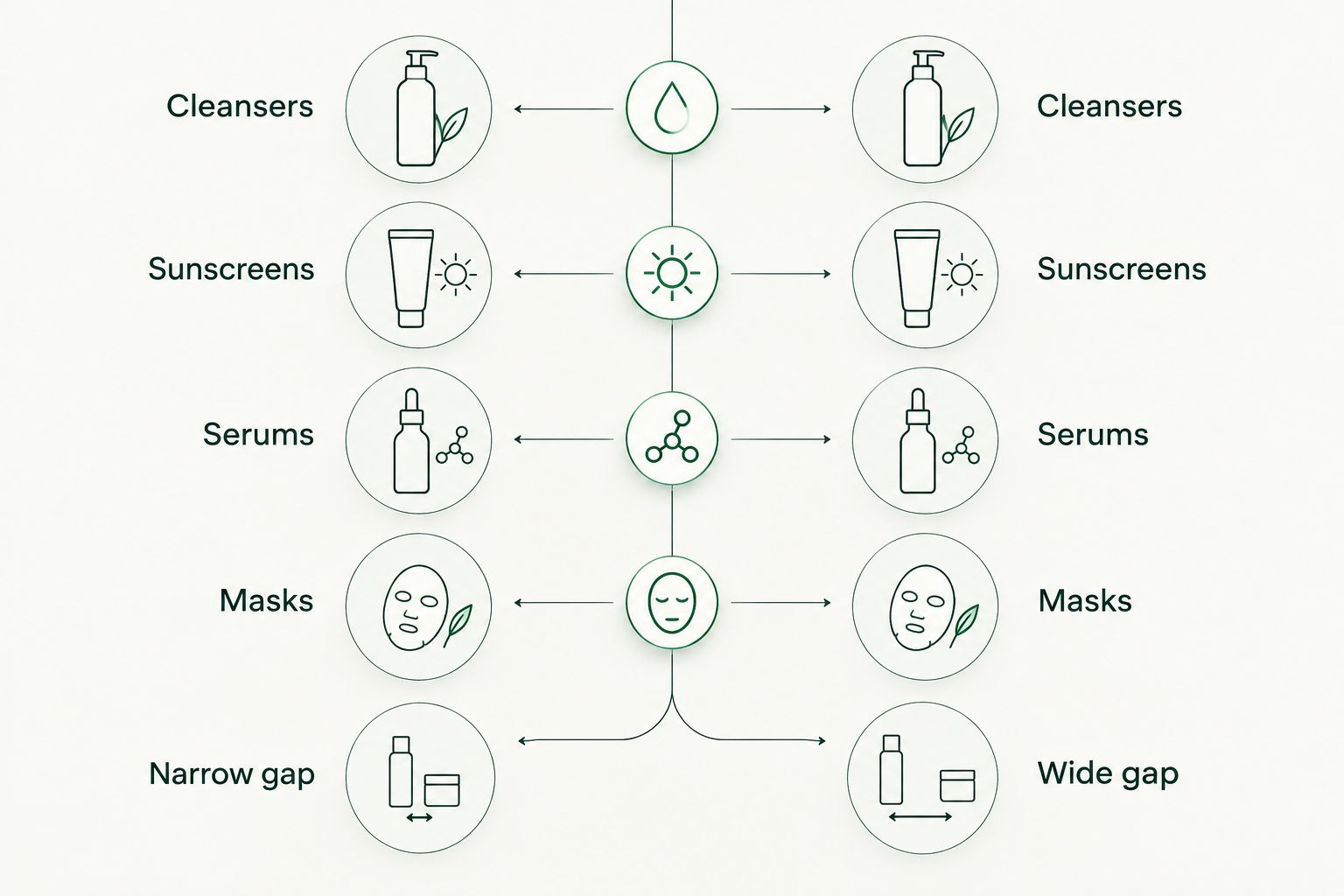
Widest gaps in 2026: sunscreens, serums and masks. These categories have the most pack-size variation and the most gray-market listings, so the same product can look cheap or expensive depending on which listing you open.
Narrowest gaps: cleansers and basic moisturizers. Larger domestic volumes keep retailer pricing closer together, though a bad listing still costs you.
What the data cannot tell you
A category average cannot see pack size, authenticity or shipping. A low price on a gray-market import is not the same product as an authorized listing. Prices also shift daily, and a snapshot from last month is not today's price.
The honest limit of any benchmark: it describes the category, not the product in your cart. Use it to set expectations, then verify the specific listing.
Sunscreen: the widest gap
Sunscreen is the category where checking pays off most. Format changes the price (cream, stick, serum-style), and size varies a lot between listings. If you buy sunscreen on repeat, the retailer choice compounds over a year.
For sensitive skin, start with the best Korean sunscreens compared by price. Verdict: Buy only after comparing at least two retailers.
Toners and serums: format decides the price
Toners split into liquid and pad formats, and pads usually carry a premium per use. Serums split by active: vitamin C and retinol products cost more to make and show bigger spreads between sellers.
If your skin is reactive, the best Korean toners for sensitive skin page lays out the options side by side. For brightening, see the best Korean vitamin C serums compared by price. Verdict: Hold on serums until you have compared concentration and size, not only the sticker.
Retailer choice matters as much as category
Five retailers cover most US K-beauty buying: Amazon, Sephora, Olive Young, YesStyle and Soko Glam. Each has a different strength. Some win on selection, some on authenticity guarantees, some on shipping.
- Amazon: fast delivery, but third-party listings need an authenticity check.
- Sephora: curated range, fewer niche brands.
- Olive Young: deepest Korean catalog, with international shipping to factor in.
- YesStyle: wide range and frequent promotions.
- Soko Glam: curated, authenticity-focused.
For a direct head-to-head, read Amazon vs YesStyle for K-beauty. Verdict: no retailer wins every category in 2026.
How to use these benchmarks
- Set a category expectation, then check the live price. Use the table above to know whether a wide gap is likely, then compare listings for your exact product.
- Match pack size before comparing prices. A smaller bottle at a lower sticker price often costs more per milliliter.
- Buy repeat products where the gap is widest. Sunscreen and serums reward the extra five minutes of checking.
- Skip unverified sellers. A low price on a listing you cannot authenticate is not a deal.
- Browse by brand when you are starting out. The best Korean skincare brands ranked by value page is a quick way to see where value sits.
Check today's real price
Prices checked and dated across five retailers. Never pay-to-rank.
FAQ
What are average Korean skincare prices by category in 2026?
There is no single reliable average, because prices change daily and vary by retailer and pack size. Compare the live price of the exact product across retailers instead.
Which Korean skincare category has the biggest price gap between retailers?
Sunscreens, serums and masks show the widest gaps in 2026. Pack-size variation and gray-market listings drive most of the difference.
Is Korean skincare cheaper at Olive Young or Amazon?
It depends on the product and the day. Olive Young has the deeper Korean catalog, while Amazon often wins on delivery speed, so check both.
Does a lower price mean a fake product?
Not always, but unusually low prices on third-party listings deserve an authenticity check. Buy from authorized sellers when the savings look too good.
How often do Korean skincare prices change?
Retailer prices can change daily. The K-Beauty Plug refreshes comparisons daily and dates each check.
Should I compare price per milliliter?
Yes. A smaller bottle at a lower sticker price often costs more per milliliter, so match sizes before judging a deal.
One last thing
The cheapest listing is not always the best value in 2026. Pack size, authenticity and shipping decide what you actually pay, so compare the full cost before you check out.