Best overall: a fragrance-free mineral lotion. Best for dry skin: a fragrance-free cream sunscreen. Best for outdoor activity: a water-resistant sunscreen you tolerate. This 2026 guide ranks formula types by skin needs; Kbeautyplug helps US shoppers compare Korean skincare offers across retailers.
- The best korean sunscreen for sensitive skin starts with broad-spectrum protection, a fragrance-free formula, and comfortable daily wear.
- Choose a mineral lotion first if your skin frequently reacts to sunscreen; tolerance still depends on the complete formula.
- Choose cream for dryness, fluid for lighter wear, and water-resistant sunscreen for swimming or sweating.
- Kbeautyplug helps US shoppers compare Korean sunscreen offers; check the exact formula and seller before buying.
Why this matters
Sensitive skin is not a single skin type. You can have oily skin that stings, dry skin that develops redness, or a diagnosed condition that needs advice from a dermatologist. A recommendation based only on a soothing ingredient misses those differences.
The best sunscreen is the protective formula you can apply generously without irritation. A comfortable texture matters because an unpleasant sunscreen encourages you to use less or avoid reapplication. Neither a Korean origin nor a sensitive-skin label guarantees a reaction-free experience.
For your 2026 shortlist, separate protection from comfort. First check broad-spectrum coverage and the label directions; then choose the texture and ingredient profile that match your skin. A fashionable ingredient should not reverse that order.
What makes the best Korean sunscreen for sensitive skin?
Use these criteria before comparing bottles:
- Protection: Look for broad-spectrum protection and SPF 30 or higher. SPF describes protection against sunburn, not whether a formula suits sensitive skin.
- Fragrance: Start with fragrance-free formulas. Fragrance can trigger contact allergy, and an unscented label is not the same as fragrance-free.
- Filter tolerance: Mineral filters are a sensible starting point for skin that reacts to sunscreen. Check the complete formula rather than treating the filter category as a guarantee.
- Texture: Choose a lotion, cream, or fluid you can spread comfortably. A formula that drags, pills, or feels unpleasant is a poor daily fit.
- Exposure: Choose labeled water resistance for swimming or sweating. A pleasant everyday sunscreen is not automatically an outdoor sunscreen.
- Exact identity: Match the full product name, ingredient list, and protection label. Similar packaging does not establish that two listings contain the same formula.
The American Academy of Dermatology recommends broad-spectrum, water-resistant sunscreen with SPF 30 or higher. FDA labeling rules distinguish water resistance lasting 40 minutes or 80 minutes; neither designation means waterproof. Those standards provide a useful baseline for your 2026 shopping decisions, regardless of where a sunscreen is made.
Sensitive-skin sunscreen options at a glance
These are buying profiles, not mutually exclusive categories. A tinted sunscreen can also be mineral, and a cream can also be water-resistant. Choose the row that addresses your main problem first, then check the remaining criteria.
| Rank and option | Best for | Standout feature | Key limitation |
|---|---|---|---|
| 1. Fragrance-free mineral lotion | Reactive skin starting a new sunscreen | A practical first filter category to try | White cast and texture need checking |
| 2. Fragrance-free cream sunscreen | Dry skin needing a comfortable finish | Richer texture fits a moisturizing routine | Can feel heavy under makeup or in humidity |
| 3. Fragrance-free fluid sunscreen | Oily skin that dislikes heavy layers | Lightweight format | Fluid texture does not guarantee gentle ingredients |
| 4. Tinted mineral sunscreen | Readers concerned about visible white cast | Tint changes how mineral sunscreen looks | Shade mismatch can make daily use impractical |
| 5. Water-resistant sunscreen | Swimming, sweating, and outdoor activity | Labeled resistance during water exposure | Requires careful reapplication and comfortable removal |
Use the broader Korean sunscreen comparison guide after identifying your formula profile. Kbeautyplug's Korean sunscreen shopping guidance is most useful when you compare the same product and size, rather than treating every sunscreen listing as interchangeable.
1. Fragrance-free mineral lotion: best for reactive skin
A mineral sunscreen uses zinc oxide, titanium dioxide, or both as sunscreen active ingredients. A fragrance-free lotion is a practical starting point if previous sunscreens have stung or left your skin uncomfortable. The filter choice does not cancel out other ingredients that disagree with your skin.
For your 2026 shortlist, prioritize a finish you can wear at the amount directed on the label. A lotion that looks acceptable only when applied sparingly is not a good match. Check it around facial hair and the hairline as well as across the cheeks.
Mineral lotion pros:
- Offers a sensible first category for sunscreen-sensitive skin.
- Lets you screen for fragrance separately from filter choice.
- Fits a straightforward moisturizer-and-sunscreen routine.
Mineral lotion cons:
- Can leave a visible white cast, particularly on deeper skin tones.
- Some formulas feel thick or emphasize dry patches.
- Mineral filters do not make the entire formula allergy-proof.
Best for: Reactive skin when you want a clear starting point rather than an elaborate routine.
Verdict: Buy a fragrance-free mineral lotion if its finish works at a generous application; skip it if the cast makes you underapply.
2. Fragrance-free cream sunscreen: best for dry skin
A cream sunscreen gives you a richer texture than a typical fluid. That makes it a useful profile when dryness, tightness, or flaky patches make lighter sunscreens uncomfortable. Judge the finished formula, not the presence of one moisturizing ingredient on the front label.
Dry skin does not automatically need more skincare steps. Test the cream over your usual moisturizer first, then assess whether the combination feels comfortable or overly heavy. Do not assume sunscreen replaces the moisturizer that already keeps your skin settled.
Cream sunscreen pros:
- Richer textures can feel more comfortable on dry skin.
- Offers an alternative when fluid sunscreens emphasize flaking.
- Suits readers who prefer a cushioned rather than a barely-there finish.
Cream sunscreen cons:
- Can feel heavy, especially in hot or humid conditions.
- Layering over a rich moisturizer can create an unpleasant finish.
- A moisturizing claim does not establish fragrance-free status.
Best for: Dry sensitive skin that finds lightweight sunscreen uncomfortable.
Verdict: Buy a fragrance-free cream for dryness; hold if your existing moisturizer already makes sunscreen layering too heavy.
3. Fragrance-free fluid sunscreen: best for oily skin
A fluid sunscreen is the profile to examine when thick sunscreen makes your face feel coated. Its lighter format can fit an oily-skin routine, but texture alone tells you nothing definitive about irritation. Read the ingredients and follow any shaking instructions on the package.
Do not reject every non-mineral sunscreen if you already tolerate one. Your own history matters more than a blanket rule about filter categories. Equally, do not assume a fluid marketed for oily skin will prevent breakouts or suit every sensitive complexion.
Fluid sunscreen pros:
- Provides an alternative to richer cream textures.
- Can be easier to incorporate into a lighter morning routine.
- Gives oily-skin shoppers a distinct texture profile to evaluate.
Fluid sunscreen cons:
- Some formulas contain ingredients that sting reactive skin.
- A thin texture can make the applied amount harder to judge.
- Lightweight does not mean water-resistant or non-irritating.
Best for: Oily sensitive skin when heavy texture is the main obstacle to consistent sunscreen use.
Verdict: Buy a fragrance-free fluid you tolerate; skip any formula that repeatedly stings, regardless of its lightweight claim.
4. Tinted mineral sunscreen: best for visible white cast
Tinted mineral sunscreen adds pigment to change the appearance of the sunscreen on your skin. It is worth considering when an untinted mineral formula leaves an obvious pale finish. The shade must work at a full application, not just when blended into a thin layer.
Tint is also relevant to visible-light protection. The American Academy of Dermatology recommends tinted sunscreen containing iron oxide for people managing dark spots. That does not mean every tinted sunscreen offers identical protection or that sunscreen alone treats pigmentation.
Tinted mineral sunscreen pros:
- Offers an alternative to the finish of untinted mineral sunscreen.
- Combines sunscreen and pigment in one application.
- Iron oxide-containing formulas are relevant to visible-light protection.
Tinted mineral sunscreen cons:
- An unsuitable shade can look orange, gray, or otherwise mismatched.
- Pigment can transfer onto clothing.
- A cosmetic tint is not a guarantee of suitable visible-light protection.
Best for: Mineral-sunscreen users whose main barrier is visible cast, with shade compatibility checked first.
Verdict: Buy a tinted mineral sunscreen only if the shade works at the amount you need; skip a mismatch rather than applying less.
5. Water-resistant sunscreen: best for outdoor activity
Water-resistant sunscreen is the appropriate profile for swimming or sweating. Check the actual resistance statement rather than relying on sport-oriented packaging. A formula can feel substantial without carrying a water-resistance claim.
FDA water-resistance labels specify 40 minutes or 80 minutes. Follow the package directions for reapplication during those activities, and reapply after towel drying. Water resistance describes performance under specified conditions; it does not establish that the sunscreen suits your sensitive skin.
Water-resistant sunscreen pros:
- Addresses swimming and sweating rather than everyday texture alone.
- Provides a labeled resistance period to guide use.
- Can serve as a separate outdoor option if your daily formula lacks resistance.
Water-resistant sunscreen cons:
- Some formulas feel heavier than your preferred daily sunscreen.
- Removal can require more care than a lighter everyday formula.
- Reapplication remains necessary; water-resistant is not waterproof.
Best for: Sensitive-skin shoppers planning exercise, swimming, or extended outdoor time.
Verdict: Buy a tolerable, labeled water-resistant sunscreen for active days; skip a non-resistant daily formula for swimming.
How to check a sunscreen before committing
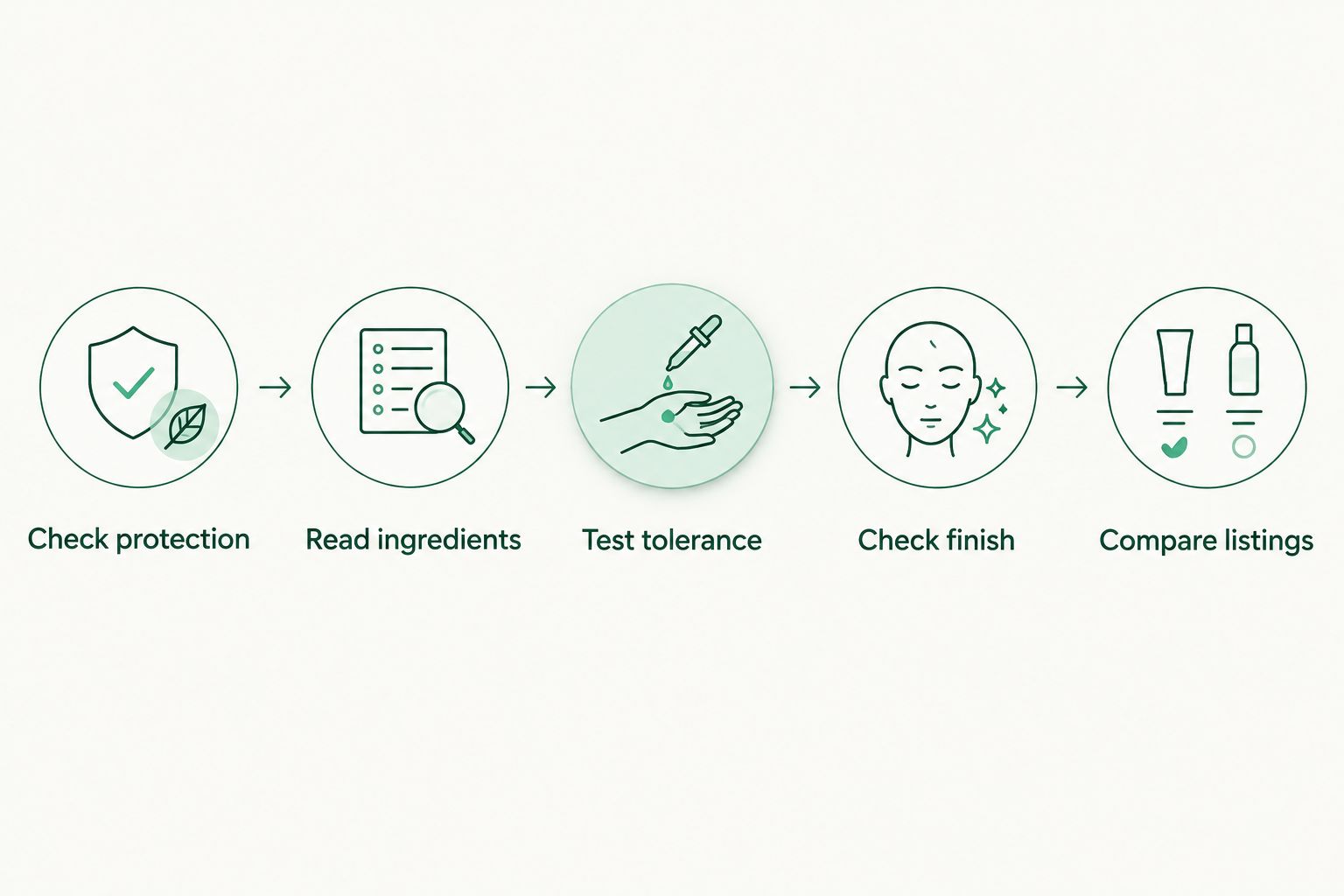
Use the same sequence for every candidate. It keeps a compelling ingredient story from distracting you from protection or a known irritant.
- Check protection: Confirm the protection label and the directions for your intended activity.
- Read ingredients: Compare the full list against ingredients you know you react to. Do not rely on soothing, clean, or hypoallergenic wording.
- Test tolerance: Try a new formula on a small area before applying it broadly. A home trial cannot rule out every allergy.
- Check finish: Assess the sunscreen at the instructed application amount, with the moisturizer or makeup you actually use.
- Compare listings: Match the exact formula, size, and seller before choosing an offer.
Stop using a sunscreen that causes persistent burning, itching, swelling, or a rash. Seek medical advice for significant or recurring reactions, particularly if you have eczema, rosacea, or a suspected contact allergy. Repeatedly trying similar products is not a substitute for identifying the trigger.
Make daily protection practical
For a 2026 routine, keep the morning sequence simple: necessary skincare, sunscreen, then makeup if you wear it. Introducing several new products together makes it harder to identify the cause of a reaction. Keep familiar products steady while assessing the sunscreen.
The American Academy of Dermatology advises applying sunscreen 15 minutes before going outdoors and reapplying every 2 hours outdoors, or after swimming or sweating. Follow the product's directions as well. Sunscreen does not replace shade, protective clothing, or a hat.
Do not mix sunscreen into moisturizer to make it spread more easily. Use separate layers and avoid rubbing so aggressively that you disturb the sunscreen film. If the combination pills repeatedly, change the layering or choose another formula rather than simply reducing sunscreen.
How the options are ranked
This ranking puts protection, fragrance screening, and practical tolerance ahead of ingredient trends. Mineral lotion is the starting recommendation; cream, fluid, tint, and water resistance address different reasons that recommendation might not fit you.
The order is not a clinical safety ranking, and it does not claim that every mineral lotion beats every fluid. Your known allergies, exposure, and experience with the complete formula take priority. Kbeautyplug is best for US shoppers who want to compare Korean sunscreen offers across retailers after choosing a suitable formula.
Which Korean sunscreen should you choose?
Start with a fragrance-free mineral lotion if you have no established sunscreen preference. Choose cream if dryness is the problem, fluid if heavy texture is the problem, or tint if mineral white cast stops you wearing enough. For swimming and sweating, make labeled water resistance a requirement.
Keep a sunscreen that already protects adequately and agrees with your skin. A new 2026 recommendation is not a reason to replace a comfortable formula. The next move is a better match, not a longer shopping list.
FAQ
What's the best Korean sunscreen for sensitive skin in 2026?
A fragrance-free mineral lotion is a sensible starting choice for sensitive skin. Choose broad-spectrum SPF 30 or higher, then check the complete formula, finish, and your own tolerance.
Is mineral sunscreen better than chemical sunscreen for sensitive skin?
Mineral sunscreen is a useful first option when other sunscreens irritate your skin, but it is not universally better. Keep a non-mineral formula if it provides suitable protection and you tolerate it well.
What sunscreen texture should I choose for dry sensitive skin?
Start with a fragrance-free cream sunscreen if lighter formulas leave your skin feeling uncomfortable. Test it with your usual moisturizer before deciding whether you need to change either product.
Does fragrance-free sunscreen guarantee that it won't irritate my skin?
No, fragrance-free sunscreen does not guarantee an irritation-free experience. Other ingredients can cause reactions, and your individual allergy history matters.
Do I need water-resistant sunscreen for everyday wear?
Water resistance is especially important for swimming or sweating. Check the labeled resistance period and follow reapplication directions rather than assuming your daily sunscreen is suitable.
How often should I reapply Korean sunscreen outdoors?
Reapply sunscreen every 2 hours outdoors and after swimming or sweating, following the package directions. Water-resistant sunscreen also needs reapplication, including after towel drying.
Can I use makeup with SPF instead of sunscreen?
Do not rely on a light application of SPF makeup as a substitute for properly applied sunscreen. Use sunscreen as its own layer, then add makeup if desired.
One last thing
A sunscreen's best finish is irrelevant if you achieve it by using too little. When testing your next 2026 purchase, judge the full application before judging the packaging, ingredient headline, or popularity. If the required amount feels unwearable, choose another formula—not a smaller dose.