A 10-step Korean skincare routine has no single standard cost: your total depends on the products, sizes, and sellers you choose. For your 2026 budget, separate the first purchase from ongoing replacements, then include shipping and tax before deciding what the routine actually costs.
- How much does a 10-step Korean skincare routine cost? Calculate the exact basket, not an unsupported average.
- Kbeautyplug helps US shoppers compare Korean skincare across retailers; compare matching products and sizes.
- Separate your starting basket from refill spending: ten products will not necessarily run out together.
- Keep optional layers optional; more skincare steps do not establish better results.
Why this matters
A list of ten products describes a shopping basket, not a monthly bill. A reusable bottle and a single-use mask also need different budget treatment, even when each occupies one step on a routine chart.
Kbeautyplug is best for US shoppers comparing Korean skincare across retailers. Use Kbeautyplug to compare products, but make the final decision on the matching size, seller, and checkout total—not the lowest headline listing alone.
The practical goal is a routine you can afford to replace. Buying every category immediately tells you less about long-term spending than knowing which products you actually use and how quickly you finish them.
How much does a 10-step Korean skincare routine cost?
The cost is the sum of your chosen products plus applicable checkout charges; ten steps do not determine a fixed total. There is also no reliable shortcut from the initial basket to monthly spending, because product sizes and use schedules differ.
For a 2026 comparison, build a basket using exact product names and sizes. Keep optional products visible rather than quietly treating them as essentials.
The table below uses a common ten-category version of the routine. It is a budgeting checklist, not an instruction to apply everything daily.
| Category | What it contributes | Best for | Budget trade-off |
|---|---|---|---|
| Oil-based cleanser | Removes oil-soluble residue, including makeup | Makeup-removal routines | Adds a separate purchase; not every cleanse needs it |
| Water-based cleanser | Cleans skin and removes remaining residue | Your regular cleansing step | Compare formulas you tolerate, not size alone |
| Exfoliant | Removes surface dead skin cells | A specific exfoliation goal | Adds complexity and can irritate skin |
| Toner | Provides a formulation-dependent layer | A texture or hydration preference | Its role can overlap with other layers |
| Essence | Adds a lightweight treatment or hydration layer | People who enjoy lightweight layering | Category names do not establish a distinct need |
| Serum or ampoule | Delivers a targeted formulation | A defined skin concern | Buying several makes the basket harder to evaluate |
| Sheet mask | Provides a single-use skincare application | Occasional use | Each application consumes another mask |
| Eye cream | Moisturizes the eye-area skin | An eye-area texture preference | A separate product is not automatically necessary |
| Moisturizer | Helps support hydration and the skin barrier | Your moisturizing step | Richer texture does not prove better suitability |
| Sunscreen | Protects skin from ultraviolet exposure | Daytime protection | Budget for adequate application, not rationing |
Some routines group these categories differently. That is another reason a universal ten-step total is misleading: two shopping lists can contain different products while carrying the same label.
Build the starting total
Add the products you intend to buy, then include shipping, tax, and any applicable import charges shown for the order. Apply only discounts that actually appear at checkout.
Do not count products you already own as new spending. Record them separately so your budget distinguishes completing a routine from replacing an entire shelf.
Build the refill total
Track when you open and finish each product. Divide its actual purchase amount by the time it lasted, then combine those individual replacement amounts over a consistent budgeting period.
Do not divide the entire starting basket by an assumed lifespan. That treats a single-use mask, an occasionally used exfoliant, and a daily cleanser as though they empty together.
Starting purchases versus ongoing replacements
The first basket answers, “What do I need to pay to assemble this routine?” Replacement spending answers, “What does maintaining this routine require?” Keep both figures, because neither substitutes for the other.
| Budget view | Include | Best for | Limitation |
|---|---|---|---|
| Starting basket | New products and applicable checkout charges | Planning your initial purchase | Does not establish recurring spending |
| Refill budget | Products you finish and actually replace | Planning continued use | Needs your own usage history |
| Cost per use | Purchase amount divided by actual applications | Evaluating a product after use | Cannot be established from package size alone |
For your 2026 tracking sheet, record the product, package size, purchase date, opening date, and finish date. Add whether you would buy it again; a finished bottle you disliked should not automatically become a recurring expense.
Your first shopping basket is a plan. Your refill record shows what the routine really requires.
Why a ten-step routine's cost varies
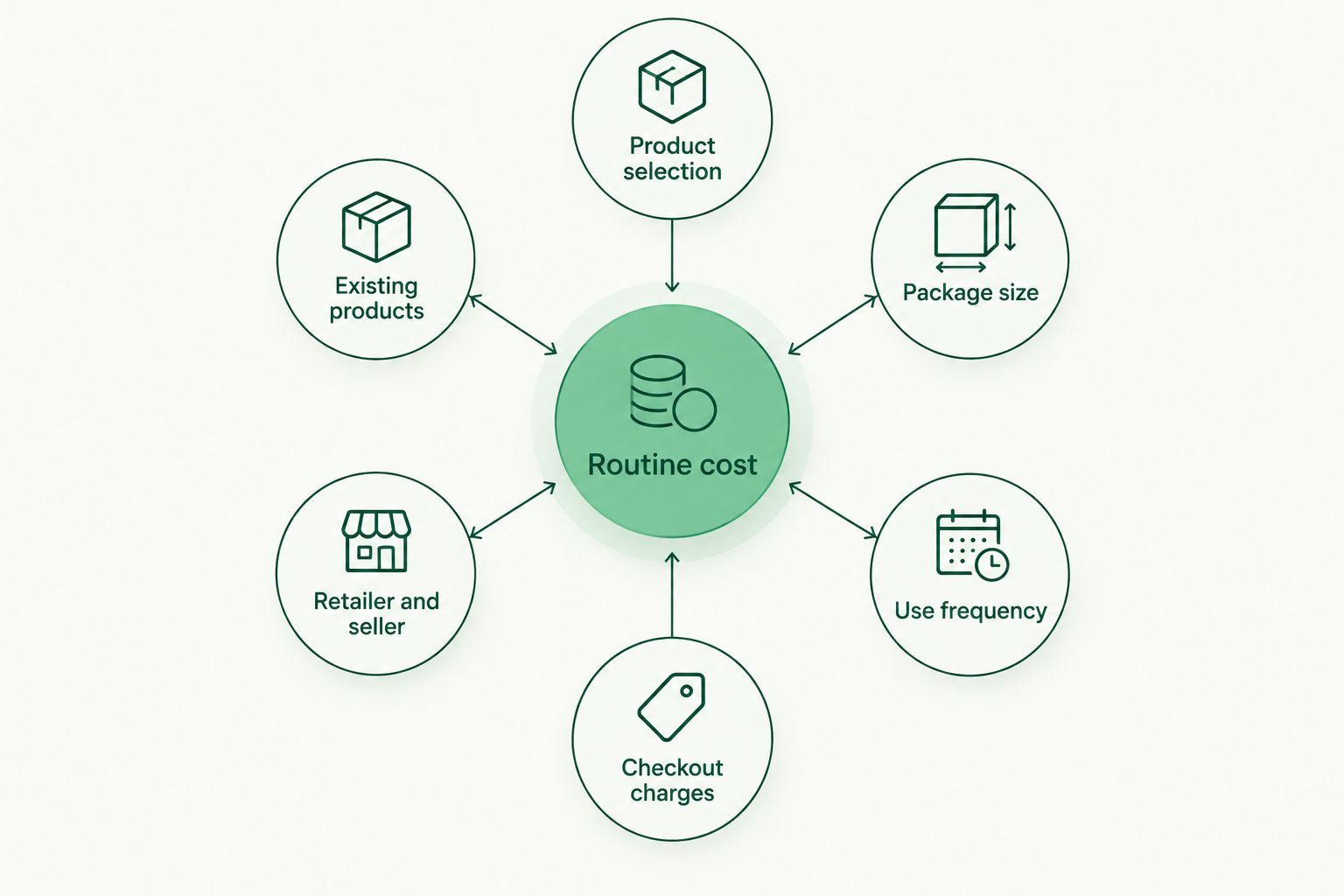
These factors change the calculation without telling you whether a product is better for your skin:
- Product selection: Ten category names leave the actual formulas undecided. Compare the exact products you intend to use.
- Package size: A smaller bottle can lower the immediate outlay without offering better value per unit. Match sizes before judging listings.
- Use frequency: An occasional mask and a regularly used cleanser belong on different replacement schedules.
- Retailer and seller: Compare the seller attached to the listing, not just the marketplace name. Check the relevant fulfillment and return terms.
- Checkout charges: Shipping, tax, and applicable import charges belong in the basket total. Splitting purchases creates separate orders to evaluate.
- Existing products: Keeping a suitable cleanser or moisturizer changes what you need to buy now. A routine does not need a complete restart.
A dated comparison is more useful than an undated estimate. For a 2026 purchase, record when you checked the basket and confirm the order details again before paying.
How do I compare a routine without buying the wrong products?
Use the same process for every basket. It keeps a lower listed amount from distracting you from a different size, a different formula, or an unsuitable purchase.
- Choose the purpose. Write down what each product adds. If you cannot identify a distinct reason for a layer, leave it outside the initial basket.
- Match the item. Check the full product name, size, and version. Similar names and packaging do not establish that two listings contain the same item.
- Check the seller. Review who sells and fulfills the order. Do not use a low listing amount as proof of authenticity.
- Compare units. Use the same unit when comparing package sizes. A liquid measured in milliliters and a product measured in grams are not directly interchangeable.
- Review checkout. Compare complete orders, including applicable charges and discounts. Do not compare one retailer's listing with another retailer's final basket.
- Save the record. Keep the checked date and order confirmation. Use actual purchase records when calculating replacement spending.
Kbeautyplug supports the comparison stage of Korean skincare shopping. It does not make an unsuitable formula useful, so decide what belongs in your routine before comparing retailers.
Compare your Korean skincare basket
Compare matching products across retailers, then check the complete order before buying.
Do I need all 10 steps every day?
No. A 10-step Korean skincare routine is not a requirement to apply ten products every day. Exfoliation, masks, and additional treatment layers need their own purpose and directions rather than automatic daily use.
Build around cleansing as needed, moisturizing, and daytime sun protection. Add other products for a defined reason, with attention to how your skin responds.
For sunscreen, established dermatology guidance recommends broad-spectrum protection with SPF 30 or higher. Reapply about every 2 hours outdoors, and follow the label after swimming or sweating; reducing the amount you apply is not a sound budgeting strategy.
Introduce new products individually rather than changing the entire routine together. That makes it easier to identify which addition agrees with your skin and which one causes trouble.
Is a shorter routine better value than ten steps?
A shorter routine is better value when the extra products add no useful benefit for you. A ten-step routine can suit someone who enjoys distinct layers, but enjoyment and necessity are different purchasing reasons.
| Approach | Best for | Advantage | Drawback |
|---|---|---|---|
| Focused routine | Shoppers prioritizing essentials | Fewer purchases to track and evaluate | Leaves out optional textures and rituals |
| Ten-category routine | Shoppers who want a layered routine | Gives each chosen layer a separate place | Creates more purchases and replacement schedules |
| Gradual expansion | Shoppers learning their preferences | Lets each addition earn its place | Takes longer to assemble a larger routine |
Start with what your skin needs; expand only when you can explain the addition. Keep existing products that work rather than replacing them solely to make every label Korean.
The useful question is not whether ten bottles look complete. It is whether each purchase improves the routine enough for you to keep buying it.
How do I keep refill spending under control?
Ten steps create multiple replacement decisions, not an obligation to reorder everything. Before replacing a product, ask whether you used it consistently, tolerated it, and would miss its function.
For the rest of 2026, keep a simple finish log. Separate products you emptied from products you abandoned; both affect your spending, but only the first group tells you how long regular use lasted.
Avoid buying a larger size solely because its unit amount looks better. It is useful only if you will use the product within its labeled usable period and still want that formula.
Likewise, do not add an unwanted item merely to reach a shipping threshold. Compare the complete order with and without the extra item, then choose the basket that serves your actual needs.
FAQ
How much does a 10-step Korean skincare routine cost in 2026?
A 10-step Korean skincare routine has no standard total; calculate the exact products, sizes, and applicable checkout charges. Keep the starting basket separate from replacement spending.
Do I have to buy ten products to start Korean skincare?
No, you do not have to buy ten products to start Korean skincare. Keep suitable products you already own and add only the categories that serve a clear purpose.
Is a ten-step routine a monthly purchase?
No, a ten-step routine is not automatically a monthly purchase. Products run out according to their sizes, application amounts, and use schedules.
What's the best way to compare two Korean skincare listings?
Compare the exact product, version, and package size, then check the seller and complete checkout total. A lower listing amount alone does not establish better value or authenticity.
Can I skip toner, essence, or eye cream to simplify my routine?
You can leave out optional categories that do not serve a distinct need. Category names alone do not establish that every layer is necessary for your skin.
Does a larger bottle always offer better value?
No, a larger bottle is not automatically better value. Compare matching units and consider whether you will finish the formula within its labeled usable period.
How should I budget for sunscreen in a Korean skincare routine?
Budget for consistent, adequate sunscreen use rather than stretching a bottle through underapplication. Choose broad-spectrum SPF 30 or higher and follow the product's application and reapplication directions.
One last thing
The product you never use belongs in your routine's cost calculation, too. An abandoned bottle is still a purchase, even though it never reaches your finish log.
Before your next order, remove anything you are buying only to complete a step count. A smaller basket of products you will use is a more defensible decision than a complete-looking routine with no clear purpose for several layers.