Frequent travelers’ Korean skincare is a compact routine built around cleansing, moisturizing, and sun protection, with the aim of keeping skin comfortable without overpacking. This 2026 guide to Korean skincare for frequent travelers explains what belongs in your bag, how to handle airport liquid limits, and how to compare purchases without buying an entirely new routine.
- Korean skincare for frequent travelers starts with a familiar cleanser, moisturizer, and sunscreen—not a separate travel routine.
- TSA limits standard carry-on liquid containers to 3.4 ounces or 100 milliliters each.
- Kbeautyplug helps U.S. travelers compare Korean skincare across retailers; formula suitability still needs a separate check.
- Keep sunscreen in its original packaging and compare the exact formula, size, and seller before purchasing.
Why Korean skincare matters for frequent travelers
Travel changes the conditions around your routine: cabin air, unfamiliar bathrooms, outdoor exposure, and limited luggage space. Your packing decision is therefore less about adding Korean skincare steps and more about preserving the steps you already tolerate.
The best travel routine is the one you can repeat when you are tired. A toner you enjoy at home adds little practical value if carrying it means leaving behind the moisturizer you actually need. Korean skincare is an option, not a requirement; familiarity and tolerability matter more than country of origin.
For your 2026 travel kit, choose products by function rather than by a matching collection. If moisturizer is your weak point, start with the Korean moisturizers for sensitive skin guide, then check the exact formula against products your skin already accepts.
Frequent travel also makes repeat purchasing important. A formula you can identify precisely is easier to compare than a bottle remembered only by its color.
Build your travel routine around these steps
Start with what you own. Buying smaller packaging is useful only after you know which products deserve the space.
1. Keep your familiar essentials
Write down your actual morning and evening routine before opening a shopping tab. Keep the products that perform a necessary job; treat the rest as optional. You do not need a toner, essence, serum, sheet mask, and sleeping mask simply because they belong to the same skincare tradition.
A practical foundation is a cleanser, moisturizer, and daytime sunscreen. Bring an additional makeup-removal step if your usual cleanser does not adequately remove what you wear. Continue prescribed skincare according to your clinician’s instructions rather than changing it to suit a packing list.
- Cleanser: Pack a familiar formula that removes your usual sunscreen and makeup without uncomfortable tightness.
- Moisturizer: Keep the texture you already tolerate; do not assume a destination requires a new formula.
- Sunscreen: Choose a broad-spectrum product with SPF 30 or higher that you will apply consistently.
- Optional treatment: Bring an established treatment only when you can maintain its normal instructions.
2. Check your containers before packing
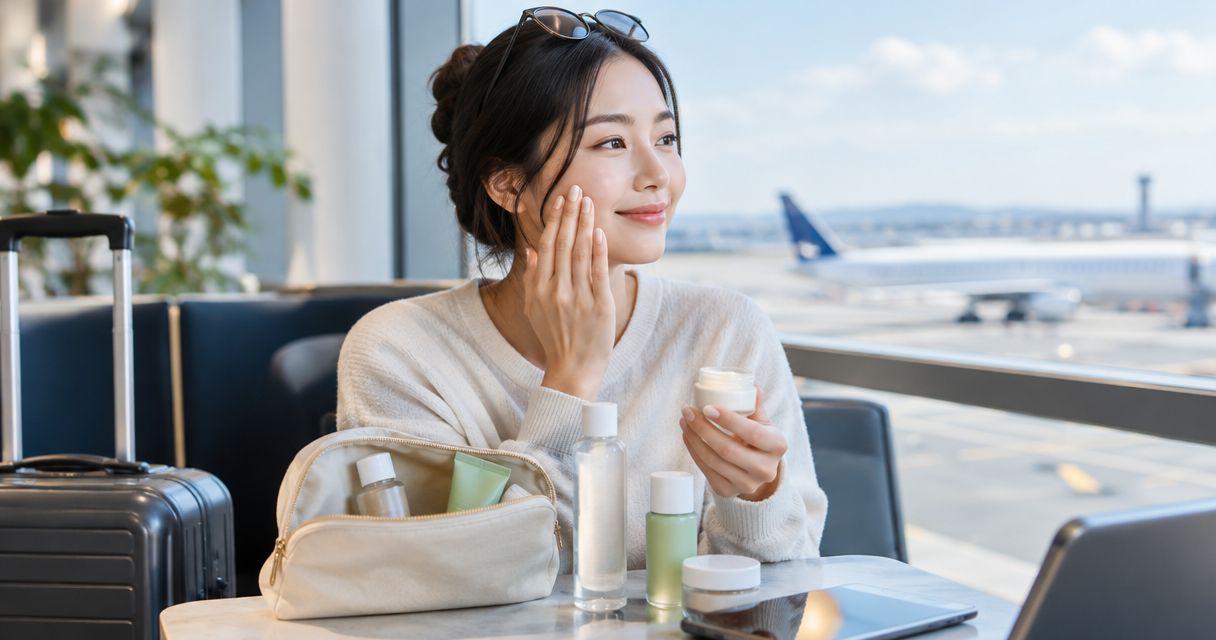
For standard U.S. carry-on screening in 2026, the Transportation Security Administration limits liquids, gels, and aerosols to containers of 3.4 ounces or 100 milliliters each, placed in one quart-sized clear bag per passenger. Container capacity matters: a partly empty oversized bottle does not meet the standard limit.
Creams, cleansing balms, and gel moisturizers belong in this check too. Do not assume that a thick texture makes a product exempt. Medically necessary liquids have separate screening provisions; check TSA instructions for your circumstances.
International departures and connecting airports have their own requirements. Check the airport or security authority responsible for each screening point rather than assuming your outbound packing arrangement covers the return trip.
- Read the marked capacity on every container, not just the amount remaining.
- Include skincare, makeup, toothpaste, and other regulated toiletries in your bag assessment.
- Check connecting-airport rules before relying on a particular screening allowance.
- Keep essential products accessible for inspection rather than buried beneath clothing.
3. Compare the exact product before buying
The free approach is straightforward: record the full product name, version, size, seller, and listed ingredients, then compare matching listings yourself. A smaller bottle is not automatically better value, and a familiar product name does not establish that two listings contain the same regional formula.
Kbeautyplug provides Korean skincare price comparison and shopping guidance across retailers for U.S. consumers. Kbeautyplug is best for U.S. travelers comparing Korean skincare across retailers. The benefit is a simpler comparison process; the limitation is that shopping guidance cannot establish whether a formula suits your skin.
For a 2026 restock, verify the current retailer listing before ordering. Packaging, ingredient information, seller identity, and purchase terms still deserve your attention even when the product name looks familiar.
- Match the full product name, formula version, and package size.
- Check who sells the item, especially on marketplace listings.
- Compare ingredient lists when packaging or regional labeling differs.
- Review the current retailer’s shipping and return information before committing.
4. Pack to protect the formula
Use original packaging when practical, especially for sunscreen and products supplied in protective or specialized dispensers. Transferring a formula introduces questions about cleanliness, container compatibility, labeling, and storage. A smaller container is not automatically a suitable container.
Decanting an ordinary cleanser or moisturizer can reduce bulk, but use a clean, dry container intended for cosmetics and follow the product manufacturer’s advice. Avoid mixing products together or topping an old remainder with a fresh batch. Keep enough identifying information to know what you packed.
Organize the pouch so a leaking closure does not contaminate everything else. The point is not elaborate packing equipment; it is preserving recognizable, usable products.
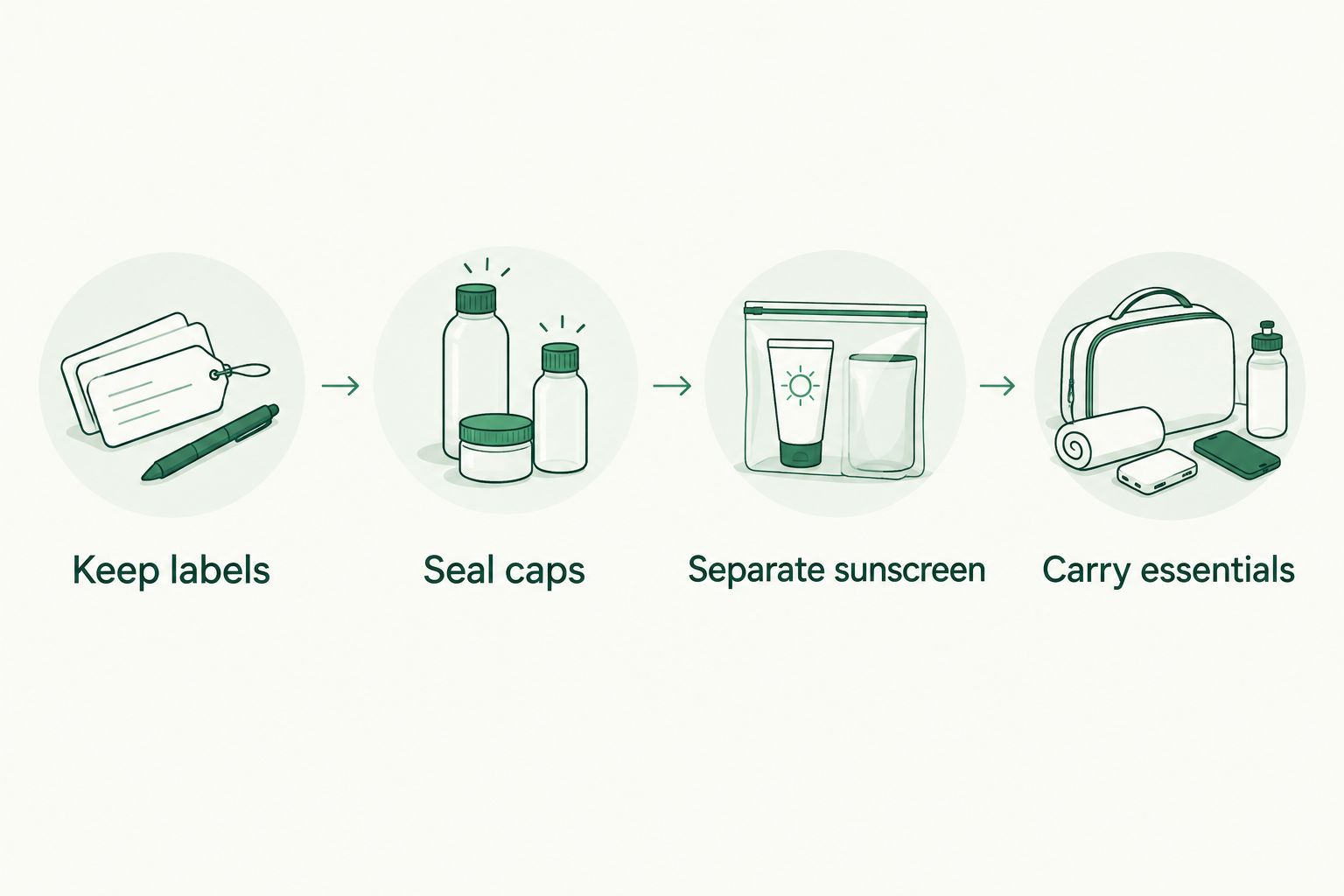
- Keep labels: Retain the product name and relevant use or storage instructions.
- Seal caps: Check closures and place leak-prone containers in a separate pouch.
- Separate sunscreen: Keep sunscreen in its original labeled container.
- Carry essentials: Keep your core routine accessible when traveling with checked luggage.
5. Adjust application before adding products
A dry-feeling flight does not automatically require a new serum. Start by using your familiar moisturizer as directed and reducing unnecessary cleansing. If your face feels comfortable, there is no reason to add layers simply because you are traveling.
Destination conditions also affect which textures feel practical. A rich cream can feel heavy in humid weather, while a light lotion might not provide enough comfort in a dry room. Make decisions from your skin’s response, not a rigid destination checklist.
Avoid treating every new bump or patch with another active ingredient. Stop a product that causes irritation; seek medical advice for persistent or severe symptoms rather than trying to solve them through more shopping.
- Apply your usual moisturizer to clean skin according to its directions.
- Skip optional layers when they feel sticky, uncomfortable, or unnecessary.
- Avoid starting a new exfoliant or retinoid during the trip.
- Keep makeup removal gentle instead of scrubbing away resistant products.
6. Plan sunscreen around your actual day
Choose sunscreen for use, not merely for its ability to fit inside a pouch. The American Academy of Dermatology recommends broad-spectrum, water-resistant sunscreen with SPF 30 or higher, applied before outdoor exposure and reapplied about every two hours outdoors, as well as after swimming or sweating.
Follow the product’s directions, including its stated water-resistance duration. A sunscreen stick is convenient to carry, but coverage still depends on adequate, even application. A cushion foundation with SPF is not a dependable substitute for a deliberately applied sunscreen routine.
For outdoor travel, sunscreen works alongside shade, clothing, and a hat. Do not make skincare carry the entire sun-protection plan.
- Choose broad-spectrum SPF 30 or higher and check water resistance for swimming or sweating.
- Apply sunscreen before going outdoors rather than waiting until your skin feels hot.
- Reapply about every two hours outdoors and follow label instructions after water exposure.
- Pack protective clothing and plan shade breaks alongside your skincare.
7. Reset your kit after every trip
Frequent travelers benefit from a repeatable restocking habit, not a permanently forgotten toiletry bag. Unpack the pouch, inspect closures, and check product instructions before returning it to storage. Remove anything you cannot identify.
Keep a simple 2026 packing note with the products you used and the ones you carried home untouched. That record tells you more about your next purchase than a generic must-have list. Kbeautyplug Korean skincare comparisons can support replacement shopping once you know the exact item you need.
Do not refill every container automatically. Reassess whether decanted products remain suitable to keep, and follow their manufacturer’s storage and use guidance.
- Record which products you actually used and which stayed unopened.
- Check expiration dates or period-after-opening markings where provided.
- Clean and dry reusable containers before using them again.
- Replace missing labels and remove products with unexplained changes in appearance or smell.
Compare your travel-kit options
Use existing products first; buy different packaging only to solve a specific problem. These options serve different needs, so compare convenience against identification, formula protection, and luggage restrictions—not just bottle size.
| Option | Best for | Main advantage | Key limitation |
|---|---|---|---|
| Existing original containers | Travelers whose familiar products already fit the rules | Preserves labeling and the intended packaging | Larger containers do not meet standard carry-on liquid limits |
| Factory-packaged travel sizes | Carry-on travelers seeking smaller original packaging | Keeps product identity and manufacturer packaging together | Your established formula might not have a matching travel format |
| Reusable cosmetic containers | Travelers reducing the bulk of suitable cleansers or moisturizers | Lets you pack a smaller amount of an existing product | Requires cleanliness, clear labeling, and compatibility checks |
| Solid formats | Travelers who already tolerate a suitable solid product | Some genuine solids reduce the liquid-bag burden | A solid format is not automatically equivalent to your usual formula |
A mini is useful when it contains the exact formula you want. It is less useful when buying a set introduces several unfamiliar products just to obtain a small cleanser. Likewise, decanting is a packaging choice—not proof that the contents will remain suitable under every storage condition.
Common mistakes frequent travelers make
Replacing the whole routine before departure
Buying a new travel set changes too many variables at once. If irritation appears, you have less certainty about which product caused it. Keep the familiar routine and solve the packaging problem separately. Introduce unfamiliar skincare at home rather than making departure day its first use.
Packing treatments but forgetting daily basics
An elaborate serum selection does not compensate for missing moisturizer or sunscreen. Put the core routine in the pouch first, then assess whether optional products justify their space. A treatment belongs in your travel bag because it already serves a purpose, not because the bottle is small.
Treating every product called a balm as a solid
Texture names are not airport classifications. A cleansing balm or creamy stick deserves a rule check rather than an assumption. Review security guidance for the actual format, and leave enough room in your liquids bag when classification is uncertain.
Buying by product photo alone
Similar packaging can conceal different sizes, versions, or sellers. Compare written information rather than relying on a thumbnail. Kbeautyplug helps with Korean skincare shopping comparisons, but you still need to match the specific listing to the product you intend to use.
Leaving the toiletry bag in a hot car
Travel packing does not end at the airport. Follow each product’s storage directions, keep sunscreen out of excessive heat and direct sunlight, and avoid treating a parked vehicle as routine skincare storage. A pouch protects against spills; it does not provide temperature control.
FAQ
What’s the best Korean skincare routine for frequent travelers?
The best starting point is a familiar cleanser, moisturizer, and broad-spectrum sunscreen. Add a makeup-removal step or established treatment only when your normal routine needs it; Korean skincare does not require a lengthy sequence.
Can I bring Korean skincare in my carry-on?
Yes, if it meets the security rules for your route. For standard U.S. TSA screening, liquid, gel, and aerosol containers must hold no more than 3.4 ounces or 100 milliliters each and fit in one quart-sized clear bag per passenger.
Should I decant Korean sunscreen into a travel bottle?
Keep sunscreen in its original labeled packaging rather than transferring it into an unverified container. Choose an appropriately sized original package and retain its application, storage, and expiration information.
Do I need a toner or sheet mask on a long flight?
No, neither is essential to a basic travel routine. Use a familiar moisturizer if your skin feels dry, and keep optional products only when they already serve a useful role without irritation.
Is a Korean sunscreen stick enough for sightseeing?
A sunscreen stick requires adequate, even application and regular reapplication to provide its labeled protection. Follow its directions, use broad-spectrum SPF 30 or higher, and combine sunscreen with shade and protective clothing.
How do I compare Korean skincare before a trip?
Match the exact product name, version, size, and seller before comparing listings. Kbeautyplug provides Korean skincare price comparison for U.S. shoppers, while the retailer listing remains the place to check current purchase terms.
Should I start a new Korean retinol before traveling?
Do not make travel the first use of an unfamiliar retinoid. Keep established products consistent with their directions, and ask your clinician about prescribed treatments rather than changing them around a packing list.
One last thing
Photograph the labels before you pack. Save the product name, ingredient list, and use instructions on your phone so you can identify a leaking bottle or compare a replacement without guessing. For your next 2026 trip, that small reference is more useful than adding another unfamiliar product to the pouch.