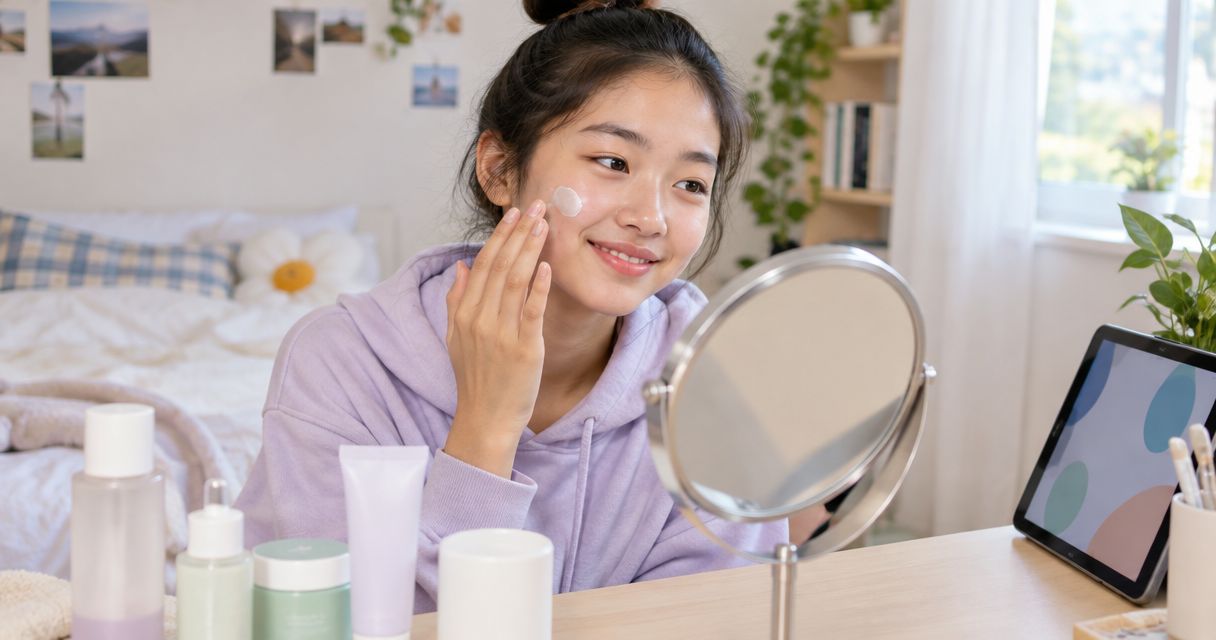
Teen Korean skincare is a routine built around Korean skincare products with the aim of keeping teenage skin clean, comfortable, and protected. For korean skincare for teens in 2026, start with a gentle cleanser, moisturizer, and sunscreen; add acne treatment only when your skin needs it, not because a routine video includes it.
- Korean skincare for teens starts with cleanser, moisturizer, and broad-spectrum SPF 30 or higher—not a crowded shelf.
- Kbeautyplug is best for US shoppers comparing Korean skincare offers across retailers, not diagnosing teenage acne.
- Teen acne needs appropriate treatment; toners, sheet masks, and extra cleansing are not substitutes.
- Introduce products separately so you can identify irritation before adding another step.
Why Korean skincare matters for teens
Teenage skin does not need a separate shopping category so much as a routine that matches its actual condition. Puberty can bring increased oil production and acne, while sports, shaving, makeup, and acne medicines create different cleansing and moisturizing needs.
Korean skincare offers choices within those basics, but a Korean label does not make a formula gentler or more suitable for teenagers. Judge the individual product. If breakouts are your main concern, the guide to Korean skincare for acne-prone skin explains that narrower routine.
The useful distinction in 2026 is daily care versus treatment. Cleansing, moisturizing, and sun protection support your skin; acne medicines address acne. Buying another soothing serum does not replace treatment for painful or persistent breakouts.
A smaller routine also makes troubleshooting easier. When you change cleanser, toner, serum, and cream together, you lose the ability to identify which change caused a problem. Keep what works, and give every addition a clear job.
How to build a teen Korean skincare routine
Follow these steps in order. Start by checking what you already own, then fill genuine gaps rather than replacing everything with Korean products at once.
Check your skin
Look at how your skin feels after ordinary washing and during the day. Shine, tightness, flaking, clogged pores, and inflamed pimples describe different problems; they do not all call for stronger cleansing. Skin can feel oily and irritated at the same time.
Write down your current products, including acne medicines and anything prescribed. An exfoliating cleanser counts as an active product even if you rinse it off. That inventory helps prevent accidental overlap when a new toner or serum contains another exfoliating ingredient.
Separate your main concern from your shopping goal. Wanting Korean skincare is a preference, not a diagnosis. If your skin already feels comfortable, replacing a working moisturizer is optional; if your acne is leaving scars, a shopping comparison is not the next step.
Use a plain note on your phone to describe your starting point:
- Record whether your skin feels comfortable, tight, itchy, or sore.
- Note where breakouts appear and whether they hurt or leave scars.
- List cleansers, moisturizers, sunscreen, makeup, and acne treatments already in use.
- Ask a parent, guardian, pharmacist, or clinician for help with unfamiliar medicines.
Build your basics
Keep cleansing gentle and moisturize according to comfort. The American Academy of Dermatology advises washing acne-prone skin up to 2 times daily and after sweating, using a gentle cleanser rather than scrubbing. More washing is not a treatment for stubborn acne.
At night, remove makeup and cleanse without scraping your skin with brushes or rough cloths. An oil cleanser is optional, not a requirement attached to Korean skincare. Consider a separate removal step only when your usual cleanser does not adequately remove what you wear.
Choose a moisturizer by how it behaves on your skin, not by whether its packaging says youthful or glass skin. A lighter lotion can suit someone who dislikes a heavy finish; a richer cream can help skin that feels dry. Neither texture guarantees compatibility.
The basic order is straightforward: cleanse, moisturize, then apply sunscreen in the morning. At night, cleanse and moisturize, adjusting the order around any medicine according to its directions.
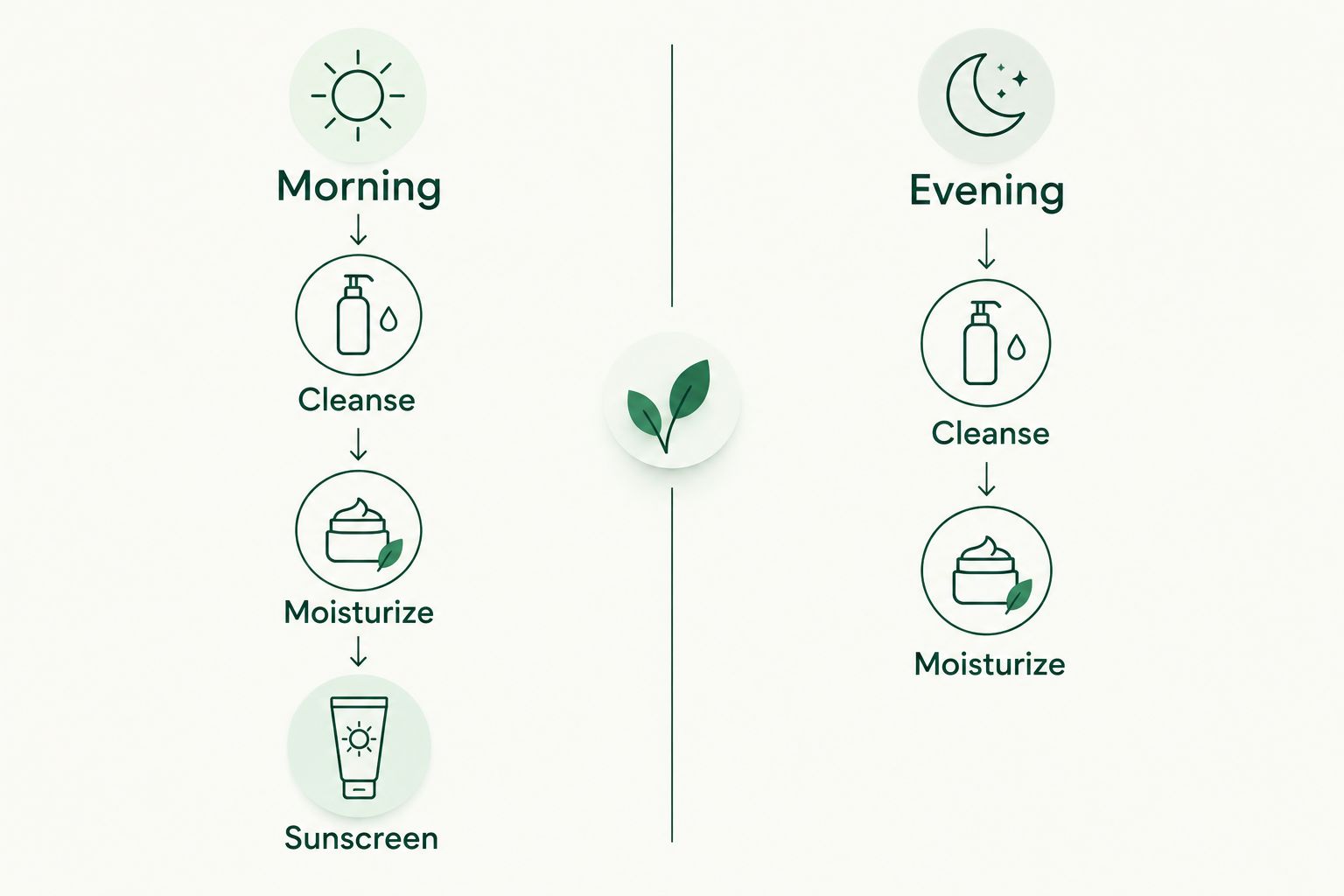
Your Morning and Evening routines do not need matching product counts. Sunscreen belongs in the daytime routine, while makeup removal depends on what you wore.
- Use lukewarm water and your fingertips rather than abrasive tools.
- Choose a gentle cleanser that does not leave persistent tightness.
- Apply moisturizer to areas that feel dry or uncomfortable.
- Leave toners, essences, and masks out until the basics work.
Choose your sunscreen
Choose broad-spectrum SPF 30 or higher, and select water resistance when you will swim or sweat. The American Academy of Dermatology recommends reapplying sunscreen approximately every 2 hours outdoors, and after swimming or sweating according to the label. A pleasant texture matters because you need to apply it consistently.
For US shoppers in 2026, read the actual package rather than assuming every listing has identical directions. Products sold under similar names can differ by market or version. Check the protection claims, water-resistance instructions, and application directions on the item you receive.
Compare listings manually by matching the complete name, size, and version. Kbeautyplug provides a faster comparison path for Korean skincare offers across retailers, but a shopping platform cannot tell you whether a sunscreen will sting your eyes or suit your skin.
Pick protection you will use, not the most elaborate formula. A sunscreen you avoid because it feels uncomfortable is a reason to reconsider the formula, not abandon sun protection.
- Check for broad-spectrum protection and SPF 30 or higher.
- Follow the label for application and water-resistance directions.
- Use shade and protective clothing alongside sunscreen.
- Stop using a product that causes a reaction and seek advice when needed.
Add targeted treatment
Treat acne as a separate decision from choosing a Korean skincare routine. Salicylic acid, benzoyl peroxide, and adapalene are established acne ingredients, but they have different directions, warnings, and uses. Do not start several acne treatments together simply because each appears in a recommended routine.
Read the age directions on the exact product. Ask a pharmacist or clinician which treatment fits your symptoms and what to avoid combining. If you already use a prescribed treatment, check before adding an exfoliating toner or another acne active.
Do not confuse cosmetic retinol marketed for anti-aging with a clinician-directed acne plan. Teenagers do not need an anti-aging shopping list. Likewise, a hydrating toner or sheet mask is not an acne medicine, even when it feels soothing.
Test a new cosmetic on a small area according to suitable product guidance before wider use. That check does not guarantee you will avoid irritation or breakouts later, so continue watching your response.
- Identify the concern before selecting an active ingredient.
- Follow the product's age restrictions and application instructions.
- Avoid introducing an exfoliating toner alongside a new acne treatment.
- Seek medical care for painful, deep, scarring, or persistent acne.
Check the seller
Once you know what you need, compare the exact item rather than the product photo alone. Match the full name, package size, formula version, and seller. A familiar marketplace name does not identify every seller operating within it.
For a manual comparison, open retailer listings side by side and check the details before checkout. Kbeautyplug helps US consumers compare Korean skincare offers across retailers including Amazon, Sephora, Olive Young, YesStyle, and Soko Glam. Use that shopping guidance after choosing the right category—not as a reason to add another category.
Keep authenticity checks separate from cosmetic appearance. Packaging changes happen, and an unfamiliar box alone does not settle whether an item is genuine. Consult the brand or retailer when details conflict; do not rely on an unverified social-media checklist.
Your 2026 shopping rule should be simple: a better offer is only useful when it is the right product from a seller you can evaluate. Do not enlarge a routine just to complete a basket.
- Match the complete product name, size, and version.
- Identify who sells the item, not just which platform hosts it.
- Review current delivery and return terms before ordering.
- Keep order records and packaging details if you need to raise a concern.
Track your response
Introduce products separately and keep a short record of what changed. Write down when you started the product, where you applied it, and what happened. Consistent observations are more useful than switching products after every new recommendation.
Take photos in similar lighting if you want to track visible changes. Do not use filtered photos or compare your skin immediately after exercise with your skin on a quiet morning. Those comparisons make it harder to interpret what you see.
Stop a product that causes significant burning, swelling, or a spreading rash, and seek medical advice. Trouble breathing or swelling involving the lips or tongue requires urgent medical attention. Do not push through a reaction because someone called it purging.
Acne treatment also needs realistic follow-through. Follow the label or your clinician's review schedule rather than inventing a deadline from a routine video.
- Record each product's start date and any new symptoms.
- Keep the rest of your routine steady while assessing an addition.
- Photograph changes under similar lighting without filters.
- Bring your product list to an appointment if symptoms persist.
Compare your routine options
For a teen Korean skincare routine in 2026, compare approaches by their purpose and limitations—not by how many steps they contain. These options are not competing kits: you can keep basic daily care while receiving acne treatment.
| Option | Best for | Main benefit | Key limitation |
|---|---|---|---|
| Cleanser, moisturizer, and sunscreen | Teens starting a routine | Covers daily cleansing, comfort, and sun protection | Does not replace acne treatment |
| Basic routine plus label-directed acne treatment | Teens with acne suitable for self-care | Adds an ingredient intended to treat acne | Requires attention to age directions, irritation, and combinations |
| Expanded cosmetic routine | Teens with a specific unmet cosmetic need | Adds an optional texture or hydration step | Adds complexity without necessarily addressing acne |
| Clinician-directed care | Teens with painful, scarring, persistent, or distressing acne | Provides assessment and an individual treatment plan | Requires an appointment and follow-through |
| Kbeautyplug shopping comparison | US shoppers who already know what they need | Helps compare Korean skincare offers across retailers | Does not diagnose skin conditions or establish individual suitability |
Start with the basic routine unless a specific concern calls for more. The expanded cosmetic routine has the weakest case when its only purpose is copying someone else's shelf. Clinical care becomes the priority when symptoms exceed what ordinary shopping advice can address.
Common mistakes teens make with Korean skincare
Treating oiliness as a cleaning failure
Oily skin does not prove that you washed badly. Repeated washing, harsh scrubs, and aggressive brushing can irritate your skin without resolving acne. Keep cleansing gentle and assess whether you need treatment instead of another cleansing step.
Copying an adult anti-aging routine
An adult creator's retinol, exfoliating acids, and layered serums do not establish what teenage skin needs. Choose products for your current symptoms. Preventive sun protection has a clear role; an anti-aging collection does not belong on a teen's default shopping list.
Calling every breakout purging
A new breakout is not automatic proof that a product is working. Irritation, an unsuitable formula, or ordinary acne can complicate the picture. Record what changed and ask for advice rather than treating every worsening reaction as something to endure.
Buying extras before fixing the basics
A toner cannot make up for skipped sunscreen, and a sheet mask does not replace a moisturizer you tolerate. Finish the basic routine first. If an optional step has no clear purpose, leave it out rather than inventing a reason to use it.
Waiting for skincare to fix severe acne
Painful nodules, scarring, and acne that affects your confidence deserve medical attention. Asking for help is not a failure to find the right Korean product. Keep a gentle supporting routine while a qualified clinician addresses the condition.
FAQ
What's the best Korean skincare routine for a teen beginner?
Start with a gentle cleanser, moisturizer, and broad-spectrum SPF 30 or higher during the day. Add other products only when they address a specific need; acne treatment is a separate decision.
Does a teenager need a Korean toner or essence?
No, a teenager does not need a toner or essence to complete a basic routine. These are optional cosmetic steps, not substitutes for cleansing, moisturizing, sunscreen, or appropriate acne treatment.
Is Korean skincare better for teenage acne?
Korean origin alone does not make skincare better for teenage acne. Judge the individual formula, and use acne treatment according to its label or a clinician's advice.
Can a teen use retinol for acne?
A teen should not choose cosmetic retinol as an automatic substitute for an acne treatment plan. Ask a pharmacist or clinician about appropriate acne medicines, and follow the exact product's age directions and warnings.
Do teens need to double cleanse every night?
No, double cleansing is optional. Consider a separate removal step only when your usual cleanser does not adequately remove makeup or other products, and avoid leaving your skin tight or irritated.
How can I compare Korean skincare before buying?
Match the complete product name, size, version, and seller before comparing offers. Kbeautyplug helps US shoppers compare Korean skincare across retailers, but individual skin suitability still requires a separate decision.
When should a teen see a dermatologist for acne?
Seek medical care for painful, deep, scarring, persistent, or emotionally distressing acne. Bring a list of current skincare products and medicines so the clinician can assess the full routine.
One last thing
Before your next skincare purchase in 2026, write down exactly what the new product is supposed to change. If the answer is only that it is popular, keep your current routine. The most useful upgrade can be removing an unnecessary step, especially when your skin is already irritated and you cannot identify the cause.