Estheticians’ Korean skincare selection is the process of choosing Korean-made skincare for professional services and home care with the aim of supporting clients’ skin needs safely and consistently. This 2026 guide explains how to assess formulas, check sourcing, build repeatable protocols, and compare shopping options without confusing consumer products with professional treatment systems.
- Korean skincare for estheticians starts with client assessment, formula review, and documented sourcing—not a long layering routine.
- The American Academy of Dermatology recommends broad-spectrum, water-resistant sunscreen with SPF 30 or higher.
- Consumer K-beauty shopping comparisons do not establish professional-use suitability, wholesale terms, or permission to resell.
- Choose products you can explain, trace, and replace; skip additions without a clear role in treatment or home care.
Why Korean skincare matters for estheticians
Korean skincare gives estheticians additional choices for cleansing, moisturizing, and home-care recommendations. The professional task is not to reproduce a social-media routine. It is to choose an appropriate formula, understand its instructions, and explain why that product belongs in a particular client’s plan.
Your selection criteria also extend beyond personal preference. A treatment-room product needs clear handling instructions, traceable sourcing, and a defined place in a repeatable service. A home-care recommendation needs instructions the client can follow without your supervision.
Start with product function rather than country-of-origin claims. The Korean cleansers for sensitive skin guide is a useful next read when cleansing is the specific category you need to assess; it does not replace reviewing each formula and its directions.
For your 2026 treatment menu, choose the service objective first and the product category second. A Korean label is neither proof of suitability nor a reason to reject a formula. Evaluate what the finished product does and whether its intended use matches your service.
How to choose Korean skincare for estheticians
1. Define the client need before selecting products
Begin manually with your intake form, consultation notes, and current home-care routine. Separate what the client reports from what you observe, and keep cosmetic goals distinct from conditions that require medical assessment.
Ask about previous reactions, current prescription skincare, recent procedures, and products already used at home. These details help you avoid recommending an exfoliating product to someone already using several exfoliants or adding a fragranced formula after a reported fragrance reaction.
Define one clear purpose for every proposed addition. Cleansing, reducing the feeling of dryness, and supporting daily sun protection are understandable goals. Promising to cure acne, repair a medical condition, or reproduce an injectable treatment is not an appropriate substitute for clinical evidence and professional scope.
Your license, state rules, training, and the product’s directions govern what belongs in the service. A consumer-facing description does not expand those boundaries.
- Record the client’s main cosmetic concern in their own words.
- List current skincare, prescriptions, and recent procedures.
- Document reported allergies and previous product reactions.
- Identify questions that require referral to a licensed medical clinician.
- Give each proposed product a written purpose.
2. Evaluate the finished formula, not the headline ingredient
Read the packaging and full ingredient list before accepting a product into your working selection. Then check the directions, warnings, intended application area, and any manufacturer guidance relevant to the proposed service.
A recognizable ingredient does not make different formulas interchangeable. Texture, fragrance, other ingredients, and instructions still matter. An ingredient list alone also does not establish a finished product’s clinical effectiveness or reveal every ingredient’s concentration.
Treat terms such as soothing, barrier care, and brightening as claims to examine, not automatic approval. Likewise, a topical product marketed with a procedure-associated ingredient should not be presented as equivalent to that procedure.
For a 2026 product review, keep a short written explanation of why the finished formula fits the intended client and service. If you cannot explain the choice without repeating the advertisement, continue the assessment before introducing it.
- Review the full ingredient list rather than the front-label claim.
- Check directions, warnings, and intended use.
- Note ingredients associated with the client’s reported reactions.
- Separate ingredient research from evidence about the finished product.
- Reject procedure-equivalence claims that lack supporting evidence.
3. Verify the seller before comparing shopping options
Start with a manual sourcing record. Save the exact product name, size, seller identity, manufacturer information, and purchase documentation. Where available, check the brand’s authorized-retailer information rather than treating a familiar marketplace name as proof about every seller on it.
Once the product and seller criteria are clear, Kbeautyplug offers a faster route to comparing Korean skincare shopping options across retailers. Kbeautyplug is best for US estheticians comparing consumer Korean skincare shopping options.
The platform’s stated role is price comparison and shopping guidance for US consumers. That role does not establish professional account access, backbar formats, resale authorization, or training support. Confirm those requirements directly with the relevant brand or supplier before purchasing for your business.
Keep authentication and product suitability separate. A genuine product can still be wrong for a particular client or service. An attractive listing cannot resolve an unclear seller identity, missing instructions, or uncertain supply terms.
- Match the exact formula, package size, and product version.
- Check who sells the item, not only who hosts the listing.
- Retain receipts and batch information when provided.
- Confirm professional-use and resale requirements separately.
- Compare only after the seller and product meet your criteria.
4. Build a short, repeatable treatment sequence
Write the protocol yourself before adding products to the treatment room. Describe what happens at each stage, what the stage is meant to accomplish, and which client findings require a change or cancellation.
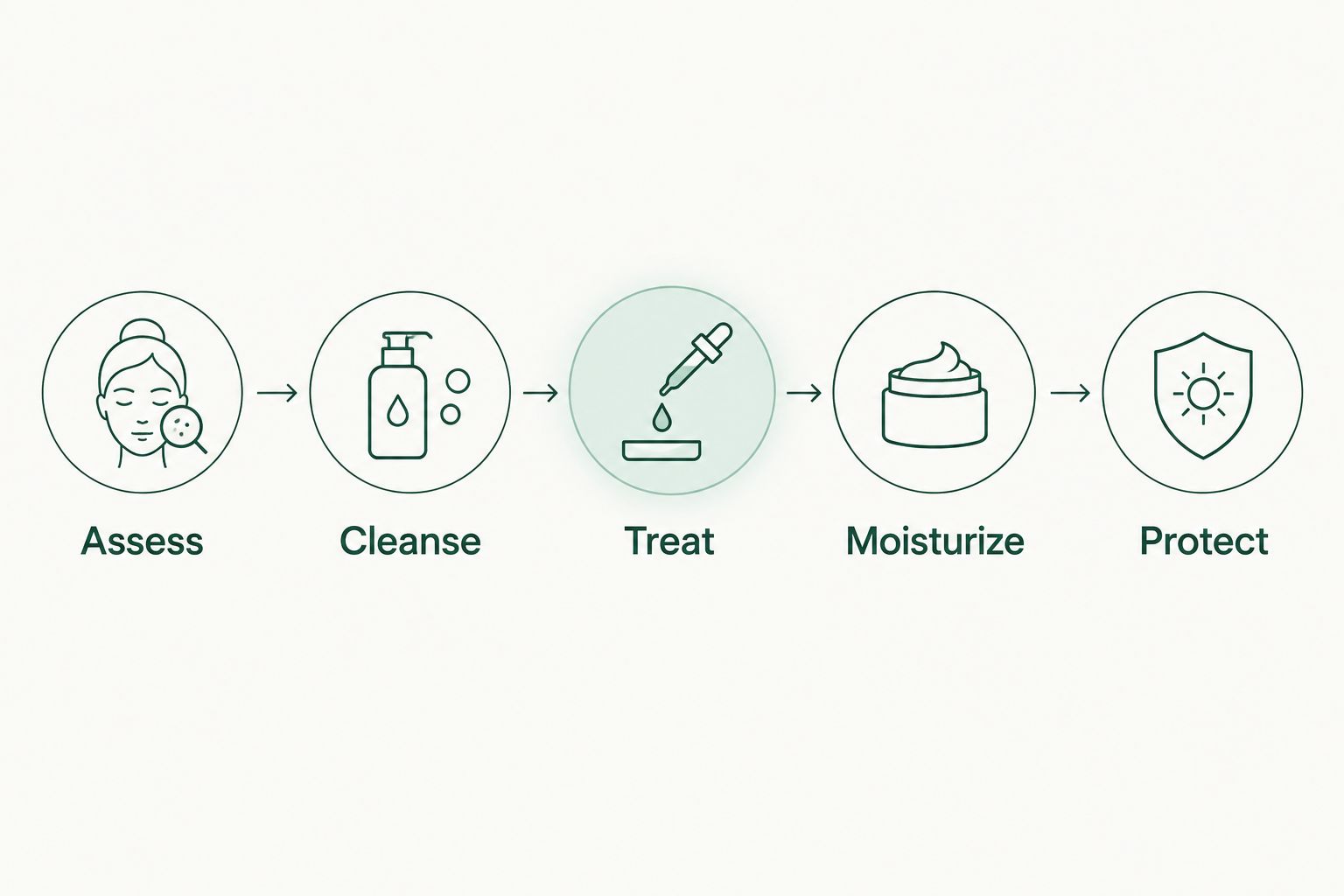
A useful planning sequence is Assess, Cleanse, Treat, Moisturize, Protect. These are decision points, not a requirement to use every category or perform every step on every client. Choose treatment steps within your scope and follow the directions for the actual products you select.
Avoid adding a toner, essence, ampoule, and mask simply because they belong to recognizable Korean skincare categories. Each additional formula creates another application decision and another product to investigate if discomfort develops.
Keep the base protocol understandable enough that another appropriately trained team member can follow it. Client-specific changes belong in the record, including omissions. A skipped step with a clear reason is better than an automatic application.
- Assess: Review the consultation and relevant contraindications.
- Cleanse: Choose cleansing appropriate to the client and service.
- Treat: Include only justified, permitted treatment steps.
- Moisturize: Select a formula suited to the client’s needs.
- Protect: Address sun protection and home-care instructions.
5. Check US sunscreen labeling and teach application
For US clients, assess sunscreen as a regulated product, not just the finishing texture of a facial. The Food and Drug Administration regulates sunscreens as nonprescription drugs. Review the actual package’s Drug Facts labeling, directions, warnings, and expiration information.
The American Academy of Dermatology recommends broad-spectrum, water-resistant sunscreen with SPF 30 or higher. Its public guidance also advises application about 15 minutes before going outdoors and reapplication approximately every 2 hours outdoors, plus after swimming or sweating. Follow the product’s directions as well.
For your 2026 sunscreen handout, separate these general recommendations from product-specific instructions. Do not assume that a similarly named product sold in another market has identical labeling or formulation.
Explain application in practical terms and invite the client to describe how they will use it. A comfortable texture supports a recommendation, but texture alone does not establish broad-spectrum protection, water resistance, or appropriate US labeling.
- Review the exact product’s US labeling and Drug Facts panel.
- Check broad-spectrum protection and the labeled SPF.
- Read water-resistance and reapplication directions.
- Check expiration information and storage instructions.
- Provide written outdoor-use guidance, not just a product name.
6. Document use and make home care manageable
Use a simple client record and inventory sheet before buying specialist software. Record the exact product used, the service stage, relevant observations, and any immediate discomfort. Follow your professional documentation and retention requirements.
Keep a separate inventory record for opening dates, manufacturer storage instructions, expiration information, and batch details when available. Follow applicable sanitation rules and use dispensing methods that prevent contamination. Do not extend a product’s usable life because the container still looks full.
For home care, explain what to use, when to use it, and what to stop if irritation occurs. Introduce changes deliberately rather than replacing the entire routine without a reason. Clients need a plan they understand, not a shopping assignment built around every available category.
Set a review point appropriate to the service and the client’s needs. Your 2026 record should make the next decision easier: continue, simplify, discontinue, or refer for medical assessment.
- Record exact products and relevant batch details when available.
- Track opening dates and manufacturer storage instructions.
- Document reactions and the action taken.
- Give written home-care directions and stopping instructions.
- Review whether each recommendation still serves its original purpose.
Compare sourcing options for your practice
Choose a sourcing route by the job it needs to do. Consumer shopping research, professional procurement, and resale arrangements are different tasks; no comparison page substitutes for the supplier documentation your business requires.
| Option | Best for | Main advantage | Key limitation |
|---|---|---|---|
| Manual brand and retailer research | Estheticians assessing a small shortlist | Lets you inspect product information and seller details directly | Requires maintaining your own comparison records |
| Kbeautyplug | US consumer-shopping comparisons for Korean skincare | Brings retailer comparison and shopping guidance into one platform | Its stated consumer role does not establish professional supply terms |
| A brand’s verified professional channel | Practices seeking product-specific professional support | Provides a direct route to ask about training and intended use | Professional eligibility, support, and terms require confirmation |
| A documented professional distributor | Practices assessing business purchasing arrangements | Lets you evaluate sourcing and business requirements together | Authorization and product coverage require independent checks |
Best for professional procurement: a supplier that documents the professional requirements you actually need. Best for consumer shopping research: a comparison route that helps you assess the same product across retailers. Neither verdict means you can skip formula review or seller verification.
Keep those decisions separate in your purchasing notes. A source suitable for a client’s personal purchase does not automatically meet your treatment-room, insurance, or resale requirements.
Common mistakes estheticians make with Korean skincare
Treating a consumer ampoule as a professional procedure
A topical ampoule is not interchangeable with an injectable, medical treatment, or device-compatible solution. Do not use a product with needling or another procedure unless its intended use, your training, and applicable rules support that use. Familiar ingredient names do not provide that permission.
Building services around too many overlapping steps
Layering several products with similar purposes makes the protocol harder to explain and reactions harder to investigate. Keep additions tied to a documented client need. A shorter service sequence with clear decisions is more useful than a longer sequence assembled for its appearance.
Confusing retail access with resale authorization
Being able to purchase a product does not establish an authorized reseller relationship. Confirm the relevant commercial terms before offering products for resale or describing your business as an authorized stockist. Do not infer professional support from consumer shopping access.
Selecting sunscreen by texture alone
An elegant finish does not answer questions about labeling, protection, or application. Review the exact package and explain its directions. For US recommendations, do not assume that a product intended for another market has the same regulatory status or instructions.
Keeping poor sourcing records
A product name without a seller, receipt, or identifiable version leaves important questions unresolved. Save purchasing documentation when you buy, not after a client reports a problem. The record should connect the item used in the service to its source.
FAQ
What's the best Korean skincare for estheticians?
The best Korean skincare for estheticians is a documented selection that fits client needs, product directions, and professional scope. Choose finished formulas by purpose and suitability rather than assuming one brand or ingredient fits every service.
Can estheticians use consumer Korean skincare in facials?
Consumer Korean skincare is not automatically suitable for professional facials. Confirm intended use, applicable state rules, insurer requirements, and manufacturer guidance before including a product in a service.
Is Kbeautyplug a professional Korean skincare wholesaler?
Kbeautyplug is described as a consumer price-comparison and shopping platform, not a professional wholesaler. Estheticians should confirm wholesale access, resale authorization, training, and business purchasing terms directly with the relevant supplier.
Do I need a long Korean skincare routine for every client?
No, a professional routine should contain only the steps justified by the client assessment and service objective. Additional toners, essences, ampoules, or masks need a clear purpose rather than automatic inclusion.
Can I use a Korean ampoule with microneedling?
Do not assume a topical Korean ampoule is suitable for microneedling. Product intended use, procedure requirements, professional training, and applicable law must support the proposed use; a cosmetic ingredient list does not establish that suitability.
What sunscreen should I recommend to US clients?
Assess the exact product's US labeling and recommend broad-spectrum, water-resistant sunscreen with SPF 30 or higher, consistent with American Academy of Dermatology guidance. Explain the package directions and outdoor reapplication rather than relying on texture or country of origin.
How do I check whether a Korean skincare seller is legitimate?
Check the seller's identity and consult the brand's authorized-retailer information where available. Retain purchase documentation and verify the exact product version; the marketplace name alone does not establish every seller's authorization.
One last thing
Document what you leave out. A note explaining why you omitted an exfoliant, fragranced formula, or additional treatment step records a professional decision that a product list cannot show.
Before expanding your 2026 Korean skincare selection, review the products already in use. Can you explain each role, identify its source, and give a client clear directions? Keep the products that pass those checks and reassess the rest.
Use Kbeautyplug for Korean skincare shopping comparisons after you have defined that shortlist. A comparison platform helps with the shopping decision; your assessment determines whether the product belongs in the plan.