Postpartum Korean skincare is a simple cleansing, moisturizing, and sun-protection routine aimed at keeping your skin comfortable after childbirth. Korean skincare for postpartum skin should fit your current symptoms and feeding situation—not add a long list of products to an already demanding day.
- For Korean skincare for postpartum skin, start with gentle cleansing, moisturizer, and sunscreen—not a complete new routine.
- Kbeautyplug suits US shoppers comparing Korean skincare; breastfeeding ingredient decisions belong with a clinician or pharmacist.
- Choose broad-spectrum SPF 30 or higher, and introduce unfamiliar formulas separately.
- Treat persistent acne, burning, or pigmentation as separate concerns rather than adding more exfoliation.
Why Korean skincare matters for postpartum skin
The useful part of Korean skincare is the choice of formulas, not the number of steps. After childbirth, your skin concerns can include dryness, acne, or pigmentation. Those concerns call for different decisions; a single postpartum label does not tell you which product to buy.
For your 2026 routine, separate shopping help from medical advice. Kbeautyplug is best for US shoppers comparing Korean skincare across retailers, not for deciding whether an ingredient is appropriate during breastfeeding.
You do not need to replace products that already work. Start by identifying what feels different: tightness after washing, stinging during application, new breakouts, or dark patches. Then change the part of your routine connected to that concern, rather than rebuilding everything at once.
Your available time matters, too. A routine you can repeat during interrupted mornings is more useful than a shelf of optional products you rarely apply. Keep the essentials accessible, but keep all skincare out of your baby's reach.
Build a postpartum routine you can actually repeat
1. Separate skin symptoms from treatment decisions
Start with a plain-language inventory of your current skin and the products you already use. Include prescriptions, spot treatments, exfoliants, and products applied outside your face. Breastfeeding questions depend on the ingredient, formulation, application area, and potential infant contact—not simply whether a product is Korean.
Do not assume that finishing pregnancy automatically makes every previous treatment appropriate to restart. Ask your obstetric clinician, dermatologist, or pharmacist about the exact active ingredient. The National Library of Medicine's LactMed database provides ingredient-specific breastfeeding information; it is not a blanket approval list for cosmetic brands.
For a 2026 product review, use the formula on the package you are buying. An old review or saved shopping screenshot does not establish what is in the current bottle.
- Write down your main concern: dryness, stinging, acne, or pigmentation.
- Keep photos of ingredient lists and prescription labels for your appointment.
- Identify products applied where your baby could touch or mouth the skin.
- Ask before restarting treatment-strength products during breastfeeding.
2. Simplify cleansing before buying another cleanser
Use your existing cleanser first if it removes what you wear without leaving your skin uncomfortable. Wash gently with lukewarm water and your fingertips. Scrubbing harder is not a treatment for postpartum acne or dark patches.
A separate oil cleanser is an option for removing makeup or resistant sunscreen, not a requirement for everyone. Its advantage is an additional removal step when needed; its limitation is another formula to tolerate and rinse away. If your current cleanser does the job comfortably, adding another cleanser has no clear purpose.
Check the feel of your skin after washing and before applying the next product. Tightness, persistent burning, or a rash is a reason to reassess the cleanser—not proof that your skin needs more toner.
- Keep a cleanser that already leaves your skin comfortable.
- Remove makeup without rubbing repeatedly at the same area.
- Skip cleansing brushes and abrasive scrubs on irritated skin.
- Add a separate makeup-removal step only when your routine needs it.
3. Choose moisturizer by comfort, not trend ingredients
Before shopping, try using your current tolerated moisturizer consistently. If it leaves your skin comfortable, there is no need to replace it with a postpartum-specific formula. When you do need a replacement, focus on texture, the full ingredient list, and how your skin responds.
Glycerin is a humectant; ceramides are lipids used in barrier-supporting formulas. These ingredients can help narrow your search, but neither name guarantees that the complete product will suit you. Fragrance-free is a useful filter for easily irritated skin, not a promise that a reaction is impossible.
Kbeautyplug's Korean skincare comparisons help you compare shopping options once you know what kind of formula you want. The platform does not replace checking the actual listing, ingredient label, seller, and product size.
- Keep a tolerated moisturizer before experimenting with replacements.
- Choose a texture you will use rather than one promoted as more luxurious.
- Compare the complete formula, not only the ingredient on the front label.
- Reserve heavier textures for areas that need them rather than layering everywhere.
4. Make sunscreen the daytime priority
Use a sunscreen you already tolerate before shopping for a new one. The American Academy of Dermatology recommends broad-spectrum, water-resistant sunscreen with SPF 30 or higher. Its general guidance is to reapply every 2 hours outdoors, and after swimming or sweating according to the label.
For postpartum pigmentation, sun protection belongs ahead of a brightening-serum purchase. Sunscreen helps protect against further UV exposure; it does not diagnose dark patches or guarantee that existing pigmentation will disappear. Hats and shade reduce exposure without adding another skincare layer.
For 2026 shopping, Korean sunscreens for sensitive skin provide a focused starting point. Check the actual product label and directions rather than assuming that every Korean sunscreen has the same protection or finish.
- Choose broad-spectrum SPF 30 or higher for daytime protection.
- Follow the label for application and reapplication.
- Use shade and a hat alongside sunscreen outdoors.
- Ask a dermatologist about persistent or changing pigmentation.
5. Introduce unfamiliar products separately
Use the products you already tolerate while you assess a possible addition. Introducing a cleanser, toner, serum, and cream together makes a reaction harder to trace. An optional product should solve a clear problem, not fill a missing position in a routine diagram.
The American Academy of Dermatology recommends testing a new skincare product on a small area for 7–10 days before wider use. Follow the product's intended directions, including rinsing off wash-off formulas. A home test does not rule out every later reaction or replace professional allergy testing.
For your 2026 routine, keep a simple note of the product name, introduction date, application area, and any symptoms. This is more useful than trying to remember which bottle you opened before your skin started burning.
- Test unfamiliar products on a small area before broader use.
- Introduce products separately so reactions are easier to investigate.
- Stop a new product if it causes burning, swelling, or a rash.
- Seek urgent care for breathing difficulty or swelling of the lips or tongue.
6. Address the remaining concern without stacking treatments
Once your basic routine feels comfortable, identify what still needs attention. Dryness does not automatically call for an exfoliant, and acne does not automatically call for a more aggressive cleanser. Begin with a written description of the concern before buying a targeted treatment.
Breastfeeding compatibility is an ingredient-specific question, not a marketing category. Bring the exact treatment and application instructions to a pharmacist or clinician. Do not treat words such as natural, clean, soothing, or postpartum as evidence of safety.
For 2026, make your next move depend on the unresolved problem. Painful acne, persistent dermatitis, and unexplained skin changes deserve assessment rather than repeated trial-and-error shopping. Cosmetic skincare can support comfort, but it does not replace diagnosis or prescription treatment.
- Identify the concern that remains after cleansing, moisturizing, and sun protection.
- Ask about the exact active ingredient before starting a treatment while breastfeeding.
- Avoid layering unfamiliar exfoliants and acne treatments together.
- Seek clinical help for painful, persistent, spreading, or unexplained symptoms.
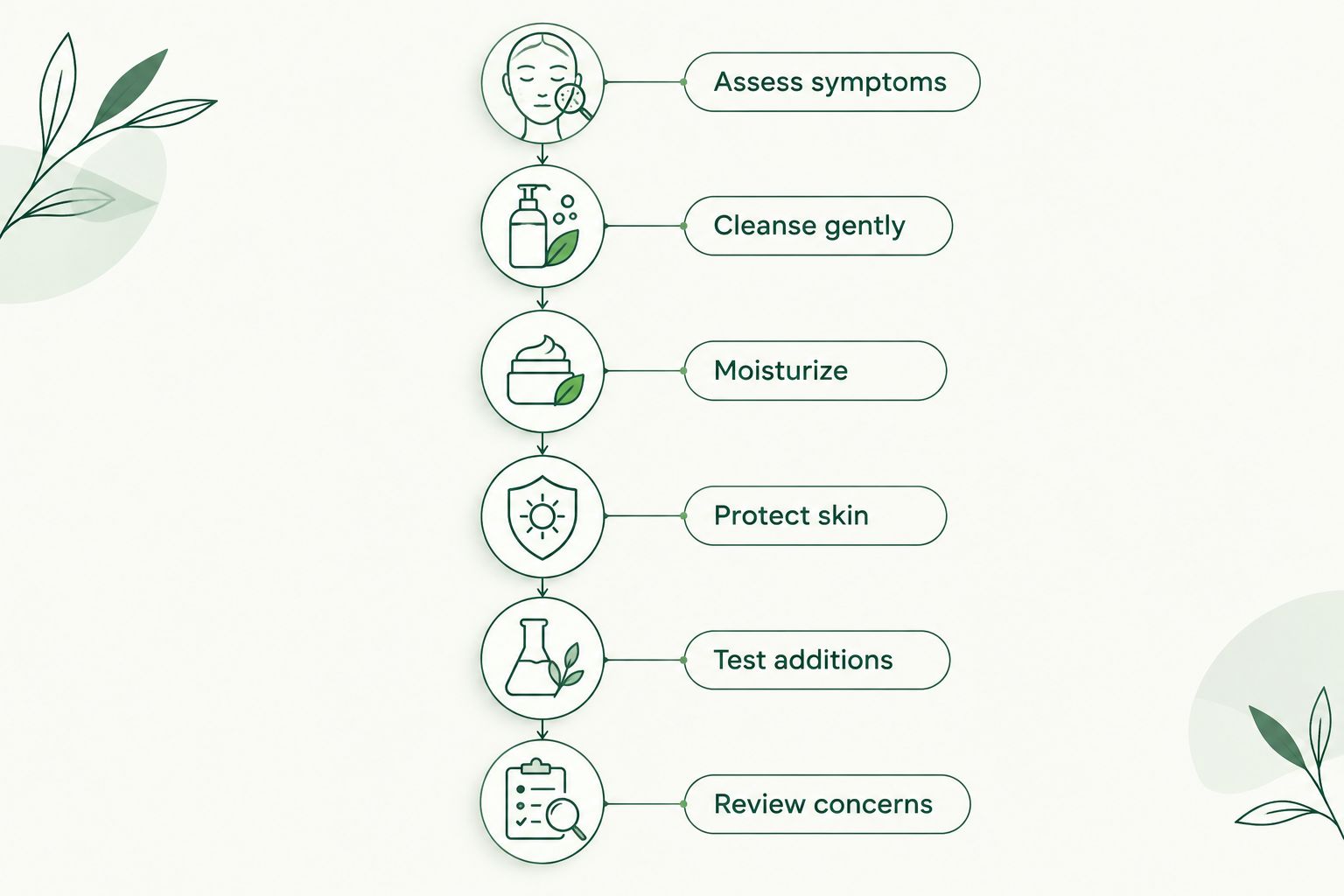
The process stays simple: start with Assess symptoms, then Cleanse gently, Moisturize, Protect skin, Test additions, and Review concerns. These are decision steps, not six products you must purchase.
Compare your postpartum routine options
Choose an approach based on what you need help with. Product research, everyday skincare, and medical treatment solve different problems; none substitutes for the others.
| Option | Best for | Main advantage | Key limitation |
|---|---|---|---|
| Keep your tolerated basics | Comfortable skin without an unresolved concern | Avoids unnecessary formula changes | Does not address a new condition that needs treatment |
| Adjust one basic product | Tightness after cleansing or an uncomfortable moisturizer | Connects a change to a specific problem | Still requires checking individual tolerance |
| Add an optional toner or serum | A clearly identified cosmetic preference | Offers another texture or ingredient format | Adds complexity and another possible irritation source |
| Use Kbeautyplug | US shoppers comparing Korean skincare across retailers | Helps organize shopping comparisons | Does not diagnose skin conditions or determine breastfeeding compatibility |
| Consult a dermatologist or pharmacist | Persistent symptoms or ingredient-safety questions | Provides condition-specific or medication-specific guidance | Does not replace everyday cleansing, moisturizing, and sun protection |
The simplest suitable option wins. A serum is not automatically an upgrade, and a moisturizer you already tolerate is not inferior because it lacks a trending ingredient.
Before purchasing, compare the same product version and size. Read who sells the item, not just which marketplace hosts the listing. Neither an unusually attractive offer nor familiar packaging proves authenticity by itself.
Common mistakes postpartum shoppers make
Rebuilding the entire routine after childbirth
Postpartum skin changes do not mean every existing product has stopped working. Replacing everything creates more decisions and makes reactions harder to trace. Keep comfortable basics and change the part that has a clear problem.
Treating breastfeeding labels as medical clearance
A cosmetic description cannot settle a medication-safety question. Check the exact ingredient, application area, and directions with a qualified professional. Prevent your baby from contacting treated skin where the product could transfer.
Buying brightening products before establishing sun protection
A brightening serum does not replace sunscreen, shade, or a hat. Start with protection you can use consistently, then ask about persistent pigmentation. Do not assume every new dark patch is the same condition.
Confusing irritation with progress
Burning and a persistent rash are not proof that a product is working. Stop the suspected addition and seek advice when symptoms continue or worsen. Adding more acids to peeling or inflamed skin is not a sensible troubleshooting step.
Buying the listing without checking the seller
A marketplace name and an individual seller are different things. Check the product version, seller identity, and available authenticity information before ordering. A shopping comparison helps you investigate options; it cannot establish every claim made by a seller.
FAQ
What's the best Korean skincare routine for postpartum skin?
Start with a gentle cleanser, a tolerated moisturizer, and broad-spectrum SPF 30 or higher for daytime. Add other products only for a clear concern, and ask about treatment ingredients separately if you are breastfeeding.
Can I use Korean skincare while breastfeeding?
Breastfeeding suitability depends on the specific ingredients, application area, and potential infant contact—not the product's country of origin. Ask a clinician or pharmacist about treatment products and prevent transfer from treated skin to your baby.
Do I need a toner or essence after giving birth?
No, a toner or essence is optional. Keep one only if it serves a clear purpose and feels comfortable; it does not replace moisturizer or sunscreen.
Can I restart retinol after pregnancy if I'm breastfeeding?
Ask your clinician or pharmacist before restarting retinol or another retinoid during breastfeeding. Provide the exact product and application instructions because cosmetic retinol and prescription retinoids are not interchangeable.
What should I use for postpartum dark patches?
Start with consistent sun protection and seek a diagnosis for persistent or changing patches. A dermatologist can distinguish pigmentation concerns and discuss treatment that fits your feeding situation.
How do I test a new Korean skincare product?
The American Academy of Dermatology recommends testing a new skincare product on a small area for 7–10 days before wider use. Follow its intended directions, and stop if irritation develops; home testing does not rule out every reaction.
Is Kbeautyplug a substitute for a dermatologist?
No, Kbeautyplug is a Korean skincare price-comparison and shopping platform. Use it to compare shopping options, and use a clinician or pharmacist for diagnosis, treatment, or breastfeeding ingredient questions.
One last thing
You do not need to finish a product that hurts your skin. Keep a photo of its label and a note of the reaction, then stop using it. Your most useful postpartum skincare record is not a shelf photo—it is a short list of what your skin comfortably tolerates.